



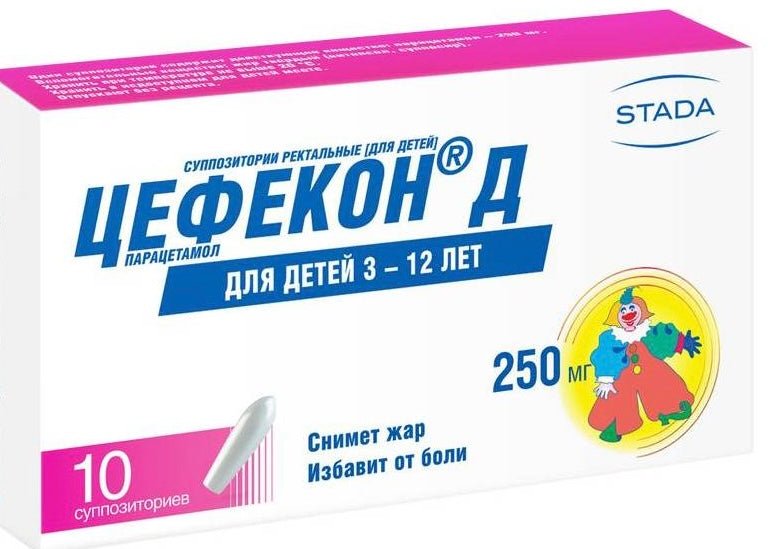


Cefecon D is a children's rectal suppository, and in many families from Russia, Ukraine and the wider CIS region it is what a parent reaches for when a baby is hot and miserable in the middle of the night. Its only key ingredient is paracetamol, the substance sold in the United States as acetaminophen. A family that keeps Cefecon suppositories and a bottle of children's acetaminophen syrup in the same cupboard is keeping the same ingredient twice, and that overlap is one of the most useful things to know about the product. The suppositories come in three strengths, 50, 100 and 250 mg of paracetamol each, matched to the child's age and weight.
On USA Apteka, Cefecon D comes in the original packaging familiar from home. Below are four parts: what Cefecon D does in the body and why it is given as a suppository, what the suppository is made of and when it is not used, how to insert it correctly and calmly, and where paracetamol from different packs can add up. A short look at the neighboring products in a family first aid kit comes at the end.
What Cefecon D is and what it is used for
Cefecon D belongs to the group of cooling and comfort-support products for children. It brings down a raised body temperature and eases mild to moderate pain, and the leaflet names exactly those two situations: a hot, uncomfortable child during a seasonal virus or a childhood bug, a reaction after a vaccination, a bump, a minor injury or a small burn that hurts.
The way paracetamol works is easiest to picture through a thermostat. Body temperature is set by the hypothalamus, a small area deep inside the brain. When the body fights off a virus, it produces prostaglandins, messenger substances that push the thermostat's setting up and at the same time make pain signals louder. Paracetamol reduces the production of prostaglandins, mostly in the brain and spinal cord. The thermostat goes back to its usual setting, the body releases the extra heat through the skin, often with sweating, and pain feels less sharp. At the site of a bruise or a sprain, paracetamol does very little to calm swelling, and that is the main difference between it and ibuprofen.
A suppository delivers the same ingredient by a different route. It melts in the rectum, and paracetamol passes into the blood through the lining of the bowel. This route helps when a child vomits a syrup right back up, refuses to swallow anything, or has finally fallen asleep. The trade-off is timing. Absorption from a suppository is slower and less even than from a syrup, so relief usually comes later, and parents who expect an effect within half an hour are often tempted to give something else on top. That is exactly the moment to wait and not add a second product.
Searching for the name alone can also bring up Cefecon N, a different suppository from the same manufacturer. It contains naproxen, caffeine and salicylamide, it is meant for adults, and it is not used in anyone younger than 16. For a child, the letter D on the box is what matters.
The goal is a child who can drink, sleep and rest, not a particular number on the thermometer. For a baby younger than 3 months, a temperature of 100.4°F (38°C) or higher is a reason to call a doctor right away, before giving anything, as the American Academy of Pediatrics advises. Babies under one month are not given Cefecon D at all. For babies between one and three months, the leaflet allows a single use for a raised temperature after a vaccination, and any other use at that age is decided by a doctor.
Cefecon D composition, the suppository base and who should not use it
The composition of Cefecon D is short. Each suppository contains paracetamol, 50, 100 or 250 mg depending on the strength, and a base of hard fat, listed in the leaflet as Witepsol or Suppocire. Both are trade names of standard suppository bases made from fatty acids of plant origin. They stay firm at room temperature and melt at body temperature, and that melting is how the ingredient is released. The suppositories are white, sometimes with a creamy or yellowish tint, and shaped like a small torpedo with a pointed end.
The three strengths match the age bands printed on the packs:
- 50 mg, for babies from one to three months, roughly 4 to 6 kg (9 to 13 lb);
- 100 mg, for children from three months to three years;
- 250 mg, for children from three to twelve years.
Within each band, the table in the leaflet sets the amount by the child's weight rather than by age alone, and it also gives the minimum gap between doses and the maximum number of suppositories in 24 hours. If a child is small or large for their age, or sits right at the edge of two bands, the strength is worth checking with a pediatrician.
According to the leaflet, Cefecon D is not used:
- in babies younger than one month;
- when a child has reacted to paracetamol or to any part of the suppository before;
- with serious liver or kidney problems;
- with glucose-6-phosphate dehydrogenase deficiency, an inherited enzyme condition that makes red blood cells fragile;
- with blood conditions such as anemia, a low platelet count or a low white blood cell count;
- after recent irritation of the rectum or the skin around the anus (proctitis or anusitis), or after rectal bleeding.
Some versions of the leaflet add diarrhea to this list. A suppository simply does not stay in place during loose stools, and an irritated lining needs rest.
The leaflet also asks for extra care, which in practice means talking to a doctor first, when a child has Gilbert's syndrome, is dehydrated, has barely eaten for several days or is significantly underweight. Paracetamol is processed by the liver, and a dehydrated, hungry body handles it less easily.
The most common local reaction is redness or soreness around the anus. Rash, itching and other allergic reactions are rare. Sudden swelling of the face or lips, or trouble breathing, is an emergency: call 911. A new rash, or a child who seems worse rather than better after a suppository, is a reason to call the pediatrician the same day.
How to insert a Cefecon D suppository
The leaflet describes the technique in a few lines, and a little preparation helps the whole thing go calmly for both the child and the parent.
Before opening the pack, it helps to check three things: that the strength matches the child's age band, that the expiry date has not passed, and when the child last had anything containing paracetamol, from any pack at all.
The steps themselves:
- Wash your hands. Short nails make it more comfortable for the child.
- If the room is warm and the suppository feels soft, put it, still sealed in its blister, into the refrigerator for a few minutes. Hard fat softens quickly, and a firm suppository is much easier to insert.
- Lay the child on their side with the upper leg bent toward the tummy, as the leaflet describes. Many parents of babies find the diaper-change position, on the back with the knees drawn up, just as convenient.
- Take the suppository out of its blister cell and hold it as briefly as possible, since the warmth of the fingers starts melting it. A drop of warm water on the tip helps it glide.
- Gently insert it, pointed end first, into the anus, just past the ring of muscle, so that it does not slip back out.
- Hold the buttocks lightly together for about a minute. The leaflet asks that the child stay lying down for one to two minutes afterward.
- Wash your hands again and write down the time.
If the timing allows, a suppository works best after the child has had a bowel movement. If it comes back out right away and whole, the question of inserting another one is best settled with the leaflet or a quick call to the pediatrician, so that the dose is not accidentally doubled. If it comes out later and has partly melted, some of the paracetamol has already been absorbed, which is one more reason to check with the pediatrician before using a new one.
The leaflet sets a gap of at least four hours between suppositories and a maximum number per day. Without a doctor's advice, Cefecon D is used for no longer than three days. If the temperature or the pain is still there after that, the child needs to be seen by a doctor rather than given another day of suppositories.
Where paracetamol from different packs adds up
Paracetamol is one of the most familiar ingredients in a home first aid kit, and that familiarity is exactly what makes it easy to give twice. The leaflet asks not to combine Cefecon D with other products that contain paracetamol, and in an ordinary household those products can look nothing alike:
- children's syrups and suspensions labeled acetaminophen, including the American brands sold in any grocery store;
- dissolving powders and combination products for seasonal discomfort, which often list paracetamol or acetaminophen in small print;
- Cefecon suppositories of another strength, bought earlier for a younger child and still sitting in the drawer.
The reason this matters is the liver. After an overdose, the first day can look deceptively calm: a child may turn pale, feel sick, sweat, vomit or complain of a tummy ache, or may seem almost fine. Signs of liver damage appear later, usually 12 to 48 hours after the extra dose. If you think a child has received more paracetamol than the leaflet allows, call Poison Help at 1-800-222-1222 or 911 right away, even if the child looks well.
Some parents alternate paracetamol and ibuprofen through a difficult night. It is a common pattern, but an alternating schedule for a child is best set with a pediatrician, with the time of every dose written down.
The American Academy of Pediatrics lists the signs that call for a doctor rather than the next dose:
- any temperature of 100.4°F (38°C) or higher in a baby younger than 3 months;
- a temperature that lasts more than 24 hours in a child from 3 months to 2 years, or more than 3 days in an older child;
- a temperature that keeps rising above 104°F (40°C);
- a child who looks very ill, is unusually drowsy or very fussy, has a stiff neck, a severe headache, trouble breathing, an unexplained rash, or repeated vomiting or diarrhea;
- a child who still acts sick after the temperature has come down.
Neighboring themes
In a home with a small child, the first aid kit fills up mostly with tubes and jars for the skin, and somewhere among them lies one pack for a hot, restless night.
- Boro Plus is the herbal cream for chapped cheeks, a scraped knee or a scratch from the playground. It looks after the skin and has nothing to do with body temperature. It is not meant for a deep or dirty wound, a burn larger than a small coin, or skin that turns red, hot and swollen a day or two later, and any of those needs a doctor. Before using it on a baby, it is worth checking the age on the tube with a pediatrician.
- Zinc balm is the white barrier layer for the diaper area. It ends up next to Cefecon D for a very ordinary reason: a few days of a stomach bug with loose stools leave the skin under the diaper red and sore, and zinc protects it. Diarrhea, though, is a poor time for suppositories, since some versions of the leaflet list it as a reason not to use them and a suppository will not stay in place anyway, so a different form of paracetamol is chosen with the pediatrician for those days. Diaper skin that blisters or does not improve within a few days also needs a doctor's eye.
- Celandine is an adult item in a family kit: small bottles of a caustic liquid for warts, applied point by point. The plant is poisonous if swallowed, and the bottles are small enough to look interesting to a toddler, so they belong on the highest shelf. Celandine is not used on a child's skin without a doctor, and anything on the face, the genitals or a mole is for a dermatologist.
Cefecon D itself is there for a temperature or pain in a child. It makes sense to keep only the strength that matches the child's age right now, to replace it as the child grows, and to store it somewhere cool.
Every family puts its kit together for its own children, and there is no single correct set. None of these products replaces a pediatrician, and the number of the pediatrician's office is worth keeping right next to the kit.
Where to find
Cefecon D can be ordered from USA Apteka in the original packaging, in strengths for different ages; current availability and the price of each pack are shown on the product card. Suppositories ship in an insulated mailer with dry ice, and the store recommends choosing expedited shipping and putting the pack in the refrigerator as soon as it arrives. Delivery within the US, including Hawaii and Alaska, is free over $69, while orders to other countries ship at a paid rate regardless of the total. The care team answers questions about a specific strength or stock in the chat on the website or on WhatsApp, and regular customers have a bonus program and seasonal sales.
The leaflet asks for storage at no more than 20°C (68°F), out of children's reach. The strength, the amount and the number of days for a particular child are decided with a pediatrician, and the leaflet inside the pack remains the main document.
Please Chat with us or send us a message on WhatsApp