


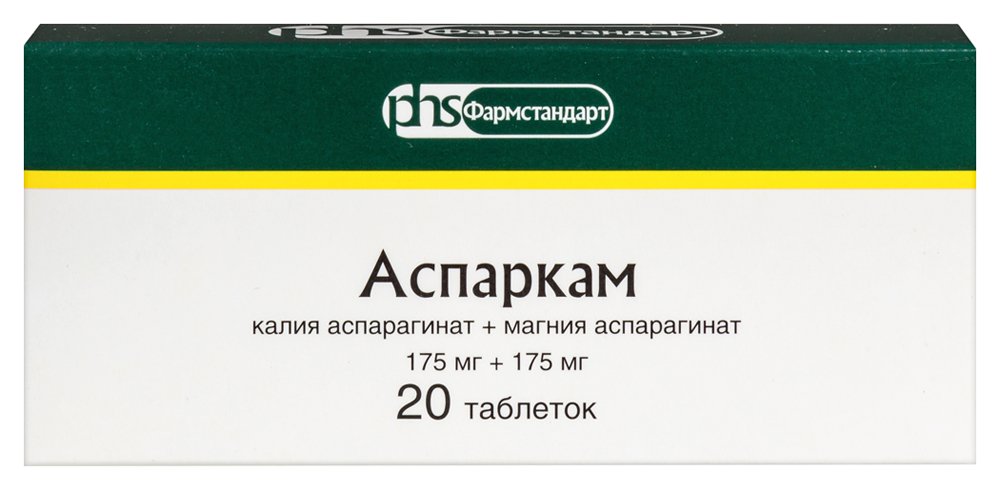


Asparkam is a familiar name for anyone who has ever been told to support their potassium and magnesium, a simple pairing of the two minerals in a form the body takes up well. Its two components are potassium aspartate and magnesium aspartate, and the aspartate part is there because it helps carry the minerals into the cells. These two minerals matter most for a steady heartbeat and for calm, working muscles, which is why Asparkam is best known in the context of the heart and of muscle cramps. On USA Apteka it comes as pieces in the original packaging of European and CIS-region producers, so a returning buyer finds a name they recognize.
This page is a plain-language guide, not a personal recommendation. Asparkam changes the balance of two minerals the heart is sensitive to, so it sits closer to a doctor’s territory than an everyday supplement, and the honest framing is that it is best used with a doctor’s involvement. The aim here is to explain what is in it, what it is taken for, and where the important cautions are, especially around the heart, the kidneys, and other items a person may already take.
What is in Asparkam
The composition of Asparkam is short and specific, two minerals in a carrier that helps them land. There is no herbal blend or long ingredient list here, just potassium, magnesium, and the aspartate that carries them.
A quick look at the makeup:
- potassium aspartate provides potassium, a mineral the heartbeat and the muscles depend on;
- magnesium aspartate provides magnesium, which works alongside potassium for steady nerves and muscles;
- the aspartate form helps both minerals cross into the cells, which is the point of the pairing;
- there is nothing else doing the work, which is exactly why the amounts and the balance matter.
Because Asparkam raises the level of two minerals the body keeps in a careful range, reading the label and knowing your own situation matters more here than with a gentle everyday supplement. The next sections cover what it is used for and where the care is needed.
What Asparkam is taken for
People take Asparkam to top up potassium and magnesium when the body is running low or when the heart and muscles need steadying support. Its honest place is as a mineral source used within a plan, most often a doctor’s.
The familiar reasons Asparkam helps with:
- support for a steady heartbeat, especially when potassium or magnesium is running low;
- as a companion to certain heart plans a doctor sets, where these minerals matter;
- to ease muscle cramps and twitches that come with low potassium or magnesium;
- through situations that drain these minerals, such as heavy fluid loss, where a doctor guides the top-up.
It helps to be plain about scale: Asparkam is a mineral source, not a general tonic, and it is most at home where a doctor has flagged that potassium or magnesium is low or that the heart needs the support. A racing, skipping, or uneven heartbeat, or ongoing weakness, is a reason to be checked rather than to self-dose, since the very minerals it provides need to stay within a careful range.
How to take Asparkam
How to take Asparkam is simple in itself, but the amount and the length of the course really belong with a doctor, because of what the minerals do.
A sensible approach:
- take the pieces after food, which is gentler on the stomach;
- follow the amount and the schedule on the leaflet, or the one a doctor has set;
- spread the daily amount through the day rather than taking it all at once;
- keep the course to what the leaflet or doctor advises rather than an open-ended run;
- do not push the amount higher on your own, since more potassium is not simply better.
One honest point stands out here: because potassium in particular has a narrow safe range, Asparkam is the kind of item where following the set amount matters more than usual, and where a doctor’s guidance is worth having rather than guessing.
Asparkam and blood pressure
A common question is how Asparkam affects blood pressure, and the honest answer is that it is not a blood-pressure product and is not taken to raise or lower pressure directly.
A few points to hold:
- potassium and magnesium take part in the normal working of blood vessels and the heartbeat, which is a background role;
- Asparkam is aimed at topping up those minerals and supporting a steady rhythm, not at moving blood pressure up or down;
- it is not a substitute for prescribed blood-pressure care, and a real reading problem belongs with a doctor;
- some blood-pressure options change how the body holds potassium, so combining them with Asparkam is exactly the situation to clear with a doctor first.
So Asparkam does not set out to change blood pressure, and where blood pressure or the heart is genuinely in the picture, the sensible path is a doctor’s plan rather than self-dosing with a mineral pair.
Asparkam without a doctor’s prescription
Another frequent question is whether it is fine to take Asparkam pieces without a doctor’s say-so, and the careful answer is that, while it is sold over the counter, it is not the best item to self-prescribe.
Why the caution:
- Asparkam raises potassium and magnesium, and potassium in particular is dangerous if it climbs too high;
- reduced kidney function, certain heart-rhythm issues, and some blood-pressure or fluid items all change how potassium is handled, and stacking Asparkam on top can push it too high;
- the symptoms it is often taken for, palpitations, weakness, cramps, can have causes that need a proper look rather than a mineral top-up;
- a simple blood test tells a doctor whether these minerals are actually low, which guesswork cannot.
So Asparkam without a doctor is technically possible but not wise as a routine, especially for anyone with a heart or kidney situation or already on other items. The steadier path is a quick word with a doctor, who can confirm the need and the amount.
Asparkam as a source of magnesium
Some people ask whether Asparkam can simply be their magnesium source, and the honest answer is that it can supply some magnesium, but it is not the best choice if magnesium is all you want.
A few points to weigh:
- Asparkam carries magnesium, so it does contribute some;
- it also carries potassium in equal focus, and that potassium load is exactly what needs care, so you cannot use it as a plain magnesium supplement;
- if the goal is only magnesium, a dedicated magnesium supplement, such as a magnesium-with-B6 or a citrate form, is the cleaner, more suitable pick;
- Asparkam makes more sense when both minerals are wanted together and a doctor is guiding the potassium side.
So as a magnesium source, Asparkam is a roundabout choice that also delivers potassium, and for magnesium alone a proper magnesium product is the better fit, with Asparkam kept for when both minerals and a doctor’s eye are in the picture.
Who should be careful with Asparkam
Asparkam has clear, important limits, more so than a gentle supplement, because of the potassium and magnesium it adds.
It is generally not used:
- with too much potassium or magnesium already in the body;
- with reduced kidney function, since the kidneys clear these minerals and they can build up;
- with certain heart-conduction issues or very low blood pressure, where a doctor guides any mineral plan;
- alongside potassium-sparing or certain blood-pressure and fluid items, which can raise potassium further;
- with a few specific conditions the leaflet names, where it is set aside.
If a course brings weakness, a slow or uneven heartbeat, tingling, or any unexpected reaction, it is stopped and a doctor is contacted, since these can be signs of too much potassium. And any heart, kidney, or blood-pressure situation is a reason to coordinate closely rather than to self-dose.
Asparkam and other themes: what it is not
A quick honest note helps place Asparkam next to other familiar items, since it is a mineral pair for the heart and muscles and has nothing to do with skin care.
Worth keeping straight:
- Asparkam works inside the body on potassium and magnesium, so it is not for the skin at all, and a scrape or a small cut is cleaned with a skin antiseptic such as Miramistin or a Furacilin rinse, a different category entirely;
- the edges of a scrape are dabbed with iodine, again a skin-surface job that has nothing to do with a mineral pair;
- Asparkam stays in its lane as a source of two minerals for the heart and muscles, while wound care and skin antiseptics keep their own place;
- none of these replaces a doctor when the heart or the minerals are genuinely in question.
In short, Asparkam is about potassium and magnesium on the inside, while skin antiseptics and wound care are a separate corner of the cabinet entirely.
A few facts about Asparkam
A few details help place this familiar mineral pair.
Worth knowing:
- it is potassium aspartate and magnesium aspartate, a source of two minerals;
- the aspartate form helps the minerals cross into the cells;
- it is best known for supporting a steady heartbeat and easing cramps tied to low potassium or magnesium;
- it is close relative to Panangin, which pairs the same two minerals;
- the date and storage terms are printed on the pack.
Common questions about Asparkam
A few questions come up again and again, and short, honest answers help.
Quick answers:
- what is it for, a source of potassium and magnesium for a steady heartbeat and for cramps tied to running low;
- does it affect blood pressure, it is not a blood-pressure product and does not set out to move it;
- is it fine without a doctor, sold over the counter, but not wise to self-prescribe, especially with a heart or kidney situation;
- can it be my magnesium source, it supplies some, but a dedicated magnesium product is the better pick if magnesium is all you want;
- how to take it, after food, in the leaflet or doctor’s amount, without pushing it higher on your own.
If a question is not answered here, the support team is glad to point to the right part of the section, while the personal decision stays with you and your doctor.
Where to find Asparkam
Asparkam is available to order from USA Apteka with delivery across the United States and abroad, as pieces in the original packaging of European and CIS-region producers, so a returning buyer recognizes the name. Delivery within the US, including Hawaii and Alaska, is free over $69, while orders to other countries ship at a paid rate regardless of the total. The support team is glad to help by chat or WhatsApp with a pack or a stock check, and regular customers have a bonus program and seasonal offers.
Storage is simple, a dry place out of direct sunlight, with the pack closed, and the date on the box. And the sensible rule for a mineral pair the heart is sensitive to is to take it in the set amount after food, and to have a doctor confirm the need and the timing, especially with any heart, kidney, or blood-pressure situation or other items in play. Take care of yourself, and let Asparkam do its focused job under a steady, sensible eye.
Please Chat with us or send us a message on WhatsApp