

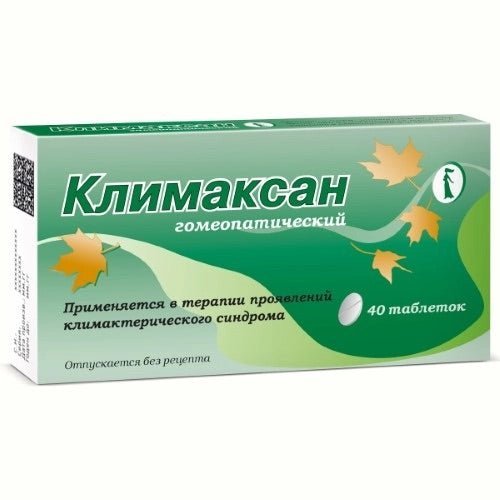

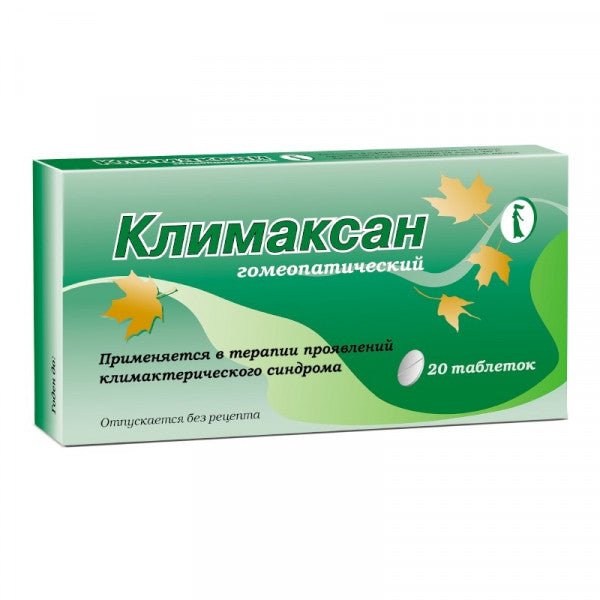

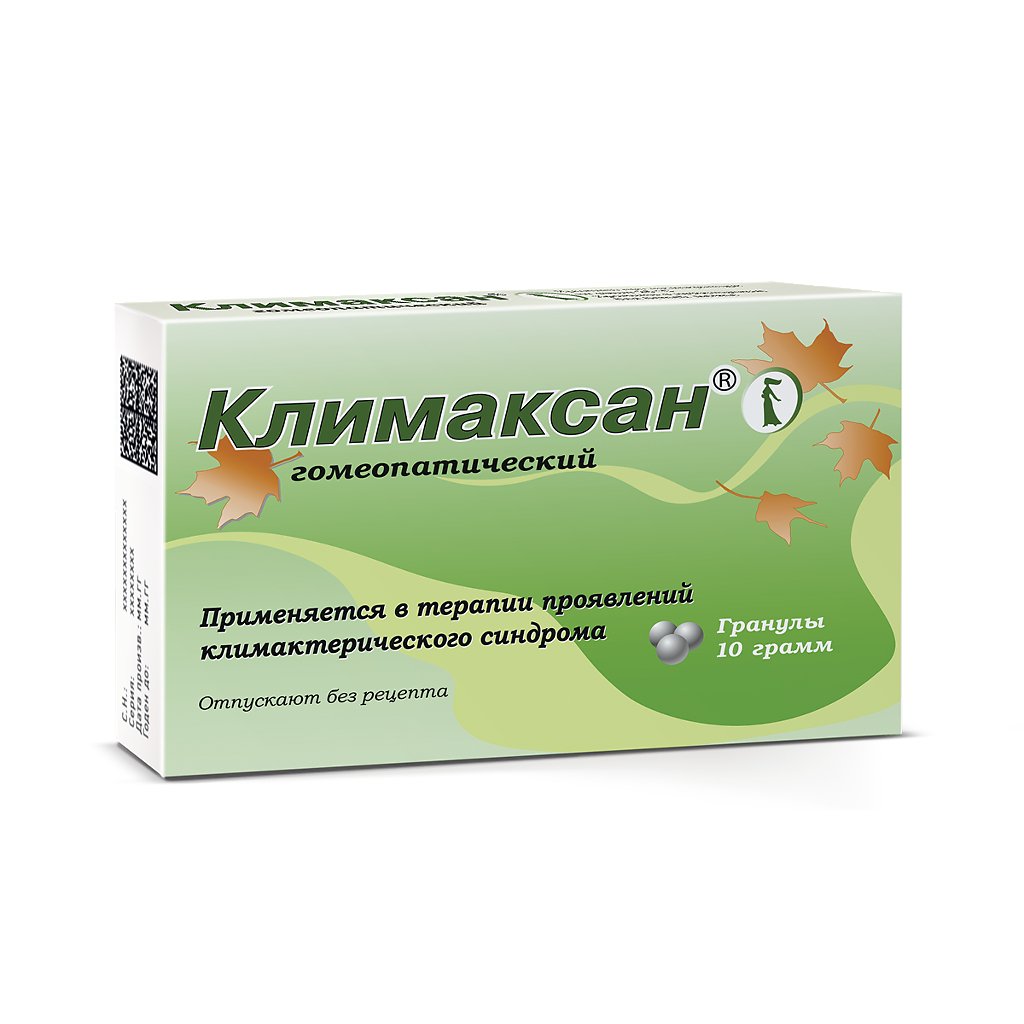

Climaxan is a homeopathic product, sold for the discomfort of the menopausal years: hot flashes, sweating, irritability, mood swings, poor sleep, headaches and a racing heart. Many women from Russia, Ukraine and the wider CIS region know the name from home, where it is one of the familiar non-hormonal options on the shelf. It comes in two forms, tablets that dissolve in the mouth and small sugar granules, and both carry the same three homeopathic components.
It is worth saying plainly from the start what Climaxan is not. It is not a hormone, it contains no estrogen or plant hormones in any measurable amount, and it is not a conventional product with an active substance in a working dose. On USA Apteka, Climaxan comes as 20 and 40 tablets and as 10 g of granules, in the original packaging. Four questions are covered below: what Climaxan is and what a homeopathic dilution means, what is inside the tablets and the granules, what the leaflet says about uses, limits and special notes, and how to take it.
Climaxan: what it is and what it is used for
The leaflet describes Climaxan as a multicomponent homeopathic product used to ease the signs of menopausal syndrome: irritability, emotional ups and downs, trouble sleeping, headache, dizziness, palpitations, sweating and hot flashes. The manufacturer explains its effect through its components.
To understand those components, it helps to know what homeopathic dilution means. Each one is diluted in a ratio of 1 to 100, and then the result is diluted again in the same ratio, many times over. The mark C200 on the pack means 200 such steps. After about the twelfth step, not a single molecule of the original substance is likely to remain, so in a C200 dilution there is none of the plant, the venom or the bee that the names refer to. That is why Climaxan has no hormonal action and cannot affect hormone levels.
What the evidence says matters here. Large reviews, including the work of the Australian National Health and Medical Research Council, have found no reliable evidence that homeopathic products work better than a placebo for any condition. Hot flashes are also known to ease noticeably in many women who take a placebo in controlled studies, so the feeling that a product has helped does not prove that the product itself did the work. This page does not claim that Climaxan relieves hot flashes or restores balance. It is a long-familiar homeopathic product that some women choose for the menopausal years, and the decision to use it is best made with a gynecologist who knows about other options.
Those options are real. For hot flashes and night sweats, a gynecologist can suggest hormone-based approaches, which remain the most effective way to ease them, as well as non-hormonal options with proven action for women who cannot or do not want to use hormones. Simple steps help too: layered clothing, a cooler bedroom, less alcohol and caffeine, and regular movement. A woman who struggles with hot flashes, sleep or mood does not have to wait it out alone. Before the visit, it helps to note when the changes began, which products she takes regularly, and whether breast cancer or blood clots have occurred in the family, because these details shape which options suit her.
Climaxan composition: what is in the tablets and the granules
The active part is the same in both forms. Climaxan contains three homeopathic components:
- Cimicifuga racemosa C200, a dilution of black cohosh, a North American plant whose root extract is used in herbal products for menopause;
- Lachesis mutus C50, a dilution of the venom of the bushmaster, a South American snake;
- Apis mellifica C200, a dilution prepared from the honeybee.
The names surprise people who read the label for the first time, but at these dilutions none of the original substances remain, as explained above.
The difference between the forms lies in the base, and that is why their limits differ:
- Climaxan tablets contain lactose monohydrate, microcrystalline cellulose and magnesium stearate. The tablets are flat, round and white or almost white. The lactose matters for anyone with lactase deficiency or lactose intolerance.
- Climaxan granules are small sugar pellets of sucrose onto which the homeopathic dilutions are applied as a water-and-alcohol mixture. The sucrose matters for people with sucrase-isomaltase deficiency, fructose intolerance or glucose-galactose malabsorption, and the leaflet notes for people with diabetes that one dose of granules contains about 0.3 g of sucrose.
It helps not to confuse Climaxan with Climadinon, which is also sold on USA Apteka. Climadinon contains an extract of black cohosh root in a measurable amount, which makes it an herbal product rather than a homeopathic one, with its own leaflet and its own cautions. The two names look alike, but they work on entirely different principles, and choosing between them is a question for a doctor.
Climaxan leaflet: uses, who should not take it and special notes
According to the leaflet, Climaxan is used to ease the signs of menopausal syndrome listed above. The leaflet sets out the following limits.
Climaxan is not taken:
- by anyone who has reacted to any of its components before;
- during pregnancy and breastfeeding, because there is no data on its effect and safety in these situations;
- in tablet form, with lactase deficiency, lactose intolerance or glucose-galactose malabsorption;
- in granule form, with sucrase-isomaltase deficiency, fructose intolerance or glucose-galactose malabsorption.
Side effects listed in the leaflet are reactions of individual sensitivity to the components. If they appear, Climaxan is stopped and a doctor is told. The leaflet also warns that homeopathic products can sometimes make existing discomfort temporarily worse at the start; in that case it advises stopping and talking to a doctor. No interactions with other products have been registered, and Climaxan does not affect the ability to drive. The leaflet also suggests seeing a doctor at least once every two months during a course.
The most important special note is not about the product itself. Some signs that seem to belong to menopause need a doctor before anything else:
- any vaginal bleeding a year or more after the last period, which always needs to be checked;
- very heavy or prolonged periods during the transition years;
- a racing or irregular heartbeat, chest pain or shortness of breath;
- low mood that lasts for weeks, loss of interest in life or thoughts of self-harm;
- hot flashes and sweating together with weight loss, a tremor or constant heat intolerance, which can point to a thyroid problem.
A homeopathic product does not replace an examination, and a regular visit to a gynecologist in the menopausal years is worth keeping regardless of what is in the cupboard.
How to take Climaxan: tablets and granules
The leaflet describes how to take each form, and the leaflet in the specific pack has the final word.
- Tablets: one tablet at a time, held in the mouth or under the tongue until it fully dissolves, without chewing or swallowing it whole.
- Granules: five granules at a time, also held in the mouth until they dissolve.
- Both forms are usually taken twice a day, in the morning and in the evening, not during a meal, at least 15 minutes before eating.
- Depending on how strong the discomfort is, the leaflet allows taking it three or four times a day.
- The length of a course is set in the leaflet; in current versions it is several months, with a doctor's visit at least every two months.
Climaxan granules are counted rather than poured, and they are easiest to tip into the cap of the tube and then into the mouth without touching them with fingers. The tablets are convenient to carry, while the granules suit women who avoid lactose. Women with diabetes can count the sucrose in the granules or choose the tablets after talking to a doctor.
It is useful to keep a simple diary for two or three weeks: how many hot flashes there were each day, how the night went and what the mood was like. Such notes help judge calmly whether anything is really changing, and they are useful at the gynecologist's appointment, because they show how much the menopausal years interfere with daily life. A phone or an ordinary notebook will do, filled in each evening while the day is still fresh.
If there is no relief after several weeks, or if hot flashes, sleep problems or mood make daily life hard, it makes sense to see a gynecologist rather than to keep taking more. A doctor can look at the whole picture and suggest options that have been shown to work.
Neighboring themes
The years around menopause are a good time to look through the home kit, because new needs appear and old habits change.
- Antigrippin is a dissolving tablet or powder for the first days of a seasonal cold, with paracetamol, chlorphenamine and vitamin C. Chlorphenamine can cause drowsiness, so it is better not taken before driving, and paracetamol is easy to double up with other products for seasonal discomfort. Climaxan does not overlap with it in any way, and if a cold comes with a high temperature that lasts more than three days or trouble breathing, a doctor is needed.
- Benzyl benzoate is an emulsion or balm for scabies, applied to the skin of the body according to its leaflet. In the menopausal years, skin often becomes drier and itchier, and that itch has nothing to do with scabies. Itching that gets worse at night, with small bumps between the fingers, on the wrists or at the waist, may be scabies, and it needs to be confirmed by a doctor before benzyl benzoate is used. For dry skin, a gentle cream is the right choice, not a scabies product.
- Duphalac is a lactulose syrup for constipation. It draws water into the bowel and softens the stool, usually within one or two days, and bloating is common at the start. The syrup contains small amounts of lactose and galactose, which matters to people who do not tolerate them. A change in bowel habits after the age of 45 or 50, blood in the stool or unexplained weight loss is a reason to see a doctor, who may suggest a screening colonoscopy.
Climaxan itself sits in the kit for the menopausal years, as a homeopathic product that some women choose, alongside regular visits to a gynecologist.
What goes into the kit in these years is each woman's own choice, and there is no list that fits everyone. None of these products replaces a doctor, and in the menopausal years a good gynecologist is worth more than any box on the shelf.
Where to find
Climaxan can be ordered from USA Apteka as tablets, 20 or 40 per pack, and as granules, 10 g, in the original packaging of its Russian manufacturer. Delivery within the US, including Hawaii and Alaska, is free over $69, while orders to other countries ship at a paid rate regardless of the total. The care team answers questions about forms, packs and stock in the chat on the website or on WhatsApp, and regular customers have a bonus program and seasonal sales.
The leaflet asks for storage in a dry place protected from light, at no more than 25 °C (77 °F), out of children's reach. Before starting a course, and especially alongside other products, a conversation with a gynecologist helps choose the right approach.
Please Chat with us or send us a message on WhatsApp