



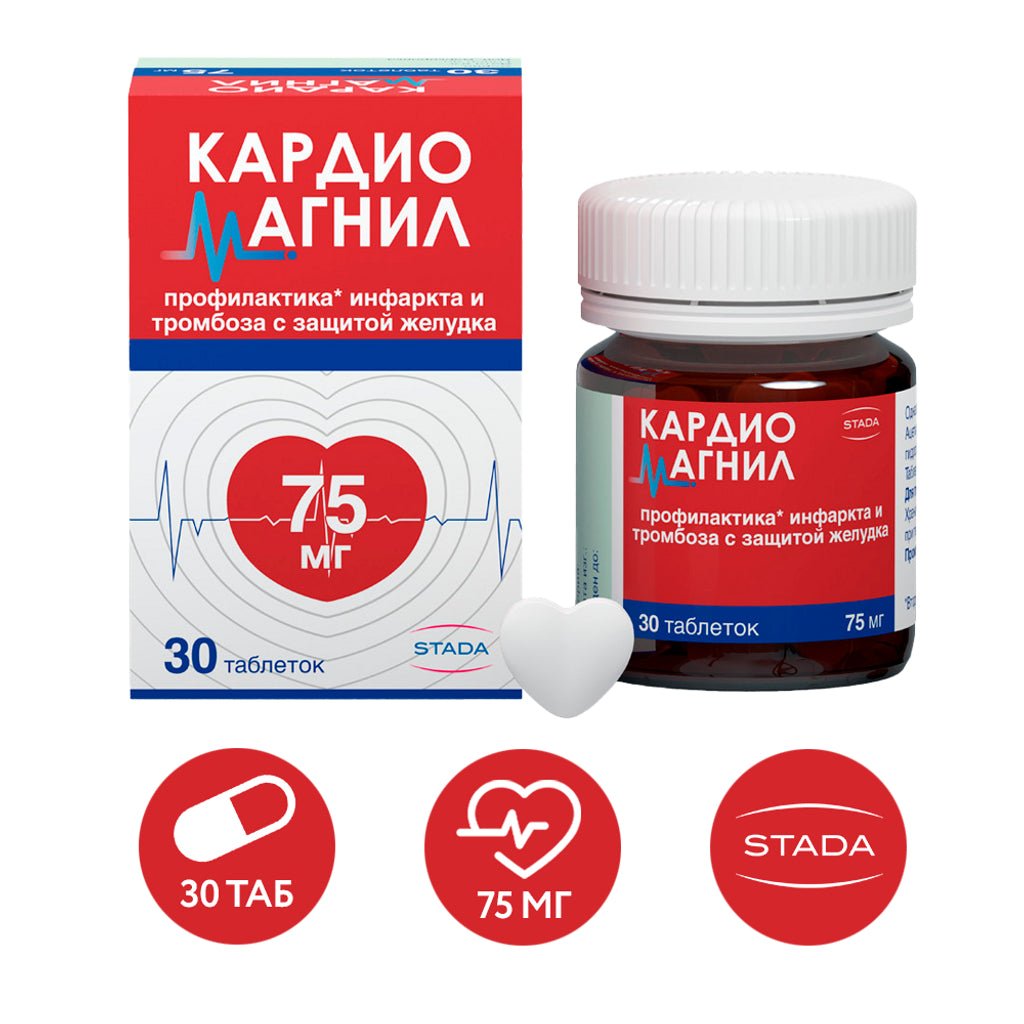

Cardiomagnyl is a coated tablet that pairs acetylsalicylic acid, the substance most people know as aspirin, in a low dose with magnesium hydroxide. Two strengths are commonly sold, a smaller everyday one and a double one, and the manufacturer’s leaflet inside the specific pack states which one is there. The aspirin is the active part of the combination. At low doses it makes platelets less inclined to clump together, so a clot forms less readily, and that single property is the reason the tablet is taken day after day for years by people who already have cardiovascular disease or a doctor-assessed high risk of a heart attack or an ischemic stroke.
The magnesium hydroxide is an antacid, included to reduce the irritation that aspirin causes to the lining of the stomach. It does not change how the aspirin works, and it does not make the product safe for a stomach that aspirin would otherwise harm. Everything below is reference information for people who have already been prescribed this treatment: who takes it, at what dose and for how long is set by a physician on the basis of individual cardiovascular risk, and nothing here replaces the leaflet or a consultation.
Who Cardiomagnyl is prescribed for and what clot prevention means
When a doctor puts someone on low-dose aspirin, the goal is narrow and specific. Inside an artery already narrowed or scarred by atherosclerosis, platelets can gather on a damaged patch and build a clot that blocks the flow, and that is the mechanism behind most heart attacks and most ischemic strokes. Aspirin reduces the tendency of platelets to stick, so that process is less likely to start. This is the whole of what the tablet does for the heart and the brain, which is why the prescription tends to be counted in years rather than days.
The groups for whom a cardiologist typically prescribes it:
- people who have already had a heart attack, an ischemic stroke or a transient ischemic attack, where the aim is to prevent a second event;
- people living with stable angina or documented coronary artery disease;
- people who have had a stent placed or coronary bypass surgery, where the cardiologist sets the whole antiplatelet plan and aspirin is one part of it;
- people carrying several cardiovascular risk factors at once, where a doctor has calculated the individual risk and judged that the benefit outweighs the bleeding risk.
For years, a generally healthy adult with no established cardiovascular disease was told that a daily low-dose aspirin was sensible insurance. Current cardiology guidance no longer recommends that routinely for primary prevention, precisely because the added bleeding risk can cancel out or exceed the protective effect. Whether a particular person belongs to the group that benefits is not a question an article can settle. It is worked out by the treating physician from age, blood pressure, cholesterol, diabetes status, smoking and personal bleeding history, and the prescription follows from that calculation rather than from a general rule.
What the tablet contains and what the magnesium is there for
The composition is short. There is acetylsalicylic acid in a low dose, and there is magnesium hydroxide, and the rest is the shell and the usual tablet fillers. The pack itself carries the exact figures, and because two strengths circulate, the smaller everyday one and the double one, the numbers printed on the box and in the leaflet are the ones that apply to that pack rather than any figure quoted from elsewhere.
Each part has a separate job:
- the acetylsalicylic acid does the actual work; at the low doses used for cardiovascular prevention it blocks an enzyme inside platelets and keeps them from clumping as readily, and that effect lasts for the life of the platelet rather than for a few hours;
- the magnesium hydroxide is an antacid that neutralizes some stomach acid at the moment the tablet dissolves, which is meant to make the aspirin gentler on the stomach lining;
- the magnesium here is not a mineral supplement and is not there for muscles, sleep or cramps; the amount and the purpose are quite different from a magnesium product;
- the shell exists so the tablet can be swallowed whole with water, and whether a particular form may be divided or chewed is stated in the leaflet rather than assumed.
The limit of the antacid is worth stating precisely, because it is the part people most often overestimate. Magnesium hydroxide softens the local irritation for some patients, but it does not protect against the main danger, which is bleeding from the stomach or the gut lining. Someone with a history of peptic ulcer or gastrointestinal bleeding is not made safe by the magnesium component, and the decision about whether such a person can take aspirin at all, or needs separate stomach protection alongside it, belongs to the doctor.
Whether it thins the blood, and what that phrase actually describes
The phrase used in ordinary conversation is that aspirin thins the blood, and it is worth replacing with something accurate, because the loose version leads to real mistakes. Aspirin does not thin blood. The blood does not become more watery, and its volume and consistency do not change. What changes is the behavior of platelets, the small cell fragments that begin the clotting process: aspirin makes them less sticky, so they are slower to gather at a damaged spot and slower to build a clot.
That puts Cardiomagnyl in a defined class. Aspirin is an antiplatelet agent. Warfarin, and the newer direct oral anticoagulants, belong to a different class, anticoagulants, which act on the clotting factors in plasma rather than on platelets. The two classes are prescribed for different reasons: an anticoagulant is typically used for atrial fibrillation, for deep vein thrombosis or for a mechanical heart valve, while an antiplatelet agent is used for arterial disease. They are not interchangeable, one is not a weaker version of the other, and a patient who switches between them without a cardiologist’s instruction can end up either unprotected or bleeding.
The same distinction explains a practical point that matters every day. Because platelets stay less sticky for several days after the last tablet, small cuts bleed longer and bruises appear more easily, and that is the expected effect of aspirin working rather than a sign that the dose is wrong. It also means that combining aspirin with an anticoagulant, with another non-steroidal anti-inflammatory drug such as ibuprofen or diclofenac, or with regular alcohol, multiplies the bleeding risk, and any such combination is something a doctor has to know about and approve.
How and when to take Cardiomagnil
The schedule comes from the leaflet of the specific pack and from the prescription, and those two take priority over any general habit. As a rule the tablet is taken once a day, at roughly the same hour, swallowed whole with a glass of water. Water matters more than it sounds: it carries the tablet past the esophagus quickly and lowers the chance of local irritation. Whether a given form may be divided or chewed is stated in the leaflet, and forms differ, so that is checked rather than guessed.
The morning-versus-evening question comes up constantly, and the accurate answer is that it has not been settled. A number of doctors suggest the evening, on the reasoning that platelet activity and cardiovascular events cluster in the early morning hours, and some patients find the evening easier for a tablet taken with food. The trials comparing morning and evening dosing have not produced a clear winner, so the difference between the two is small next to the difference between taking it consistently and taking it erratically. If the prescribing doctor has named a time, that instruction stands.
A few practical points that tend to matter more than the hour:
- consistency beats optimization, since the protective effect depends on the tablet being taken every day rather than on the exact minute;
- taking it with or just after food, with a full glass of water, suits most people whose stomach is sensitive;
- a missed tablet is not made up by doubling the next one, and the leaflet explains what to do in that case;
- a planned operation or a dental extraction is told to the surgeon, doctor or dentist in advance, since they decide whether it is paused and for how long, and that pause is never arranged by the patient alone.
How long it is taken and why stopping on your own is risky
Cardiomagnyl is preventive therapy, not a course of treatment with an end date written on the box. When it is prescribed after a heart attack, a stroke or a stent, the expectation is usually long-term use, measured in years and often indefinitely, with the doctor reviewing it periodically alongside blood pressure, kidney function and any new medicines. There is no standard interval after which it is paused for a rest, and the idea of taking it in seasonal courses comes from a different category of product entirely.
The reason self-directed stopping is treated seriously is physiological. After a cardiovascular event, or after a stent, the protection depends on continuous suppression of platelet activity, and stopping abruptly removes it within days. Studies of patients who discontinued low-dose aspirin on their own after such an event have linked the gap to a measurable rise in clotting risk in the following weeks. This is why the decision to start, to pause or to stop belongs to the treating doctor, including the pause before surgery, which is planned rather than improvised.
The review that a doctor carries out over the years is not a formality either. Kidney function changes with age, new prescriptions arrive from other specialists, an ulcer may appear, or the balance of benefit and bleeding risk may shift. Any of those can change whether it is still the right choice, or whether stomach protection should be added beside it. The patient’s part in that is to report new symptoms, to keep a current list of everything they take, including over-the-counter painkillers and supplements, and to bring it to the appointment.
Blood pressure, contraindications and situations where it is not appropriate
A frequent misunderstanding deserves a direct answer: Cardiomagnyl is not a blood pressure medicine. It does not lower blood pressure, it is not taken when a reading is high, and it does nothing for a hypertensive episode. The reason blood pressure enters the conversation at all is a different one. Severely uncontrolled hypertension raises the risk of bleeding, including bleeding into the brain, so it is one of the situations a doctor weighs before prescribing an antiplatelet agent at all. There is no threshold number that a reader should take from an article and apply at home; the treating doctor decides, usually by bringing the pressure under control first.
The contraindications and cautions stated in the leaflet are specific, and they are the part of this page worth reading twice:
- an active peptic ulcer, or gastrointestinal bleeding, in which case it is not taken;
- a known bleeding disorder, or a history of bleeding that has needed treatment;
- hypersensitivity to aspirin or to other non-steroidal anti-inflammatory drugs, including aspirin-induced asthma, where a dose can trigger a severe reaction;
- severe kidney or severe liver impairment;
- pregnancy, especially the third trimester, and breastfeeding, neither of which is a self-managed decision;
- children and teenagers with a viral illness, who must not be given aspirin because of the risk of Reye’s syndrome, a rare but life-threatening condition affecting the liver and brain;
- planned surgery or a dental extraction, which is disclosed to the doctor or dentist in advance;
- concurrent use of other non-steroidal anti-inflammatory drugs, of anticoagulants, or regular alcohol, each of which raises bleeding risk and has to be discussed rather than assumed to be harmless.
None of this makes Cardiomagnyl dangerous in the hands of the patients it was prescribed for. It explains why it is prescribed individually rather than bought on a hunch, and why a doctor asks about the stomach, the kidneys and everything else in the cabinet before writing it.
Side effects and the warning signs that need urgent care
The side effects of low-dose aspirin are predictable, and almost all of them sit in one of two places, the stomach or the clotting system. Knowing which are ordinary and which are urgent is the practical skill here, and it is worth going over with the prescribing doctor at the start rather than in the middle of a bad night.
What patients report most often:
- stomach pain, heartburn or a burning feeling after the tablet, particularly on an empty stomach;
- nausea, and less commonly indigestion or a reduced appetite;
- bruises appearing more easily, and small cuts or nosebleeds bleeding for longer than they used to;
- heavier bleeding from the gums when brushing;
- allergic reactions, from a rash to, rarely, bronchospasm in people sensitive to aspirin and related compounds.
Two signs are different in kind and mean urgent medical attention rather than a call in the morning: black, tarry stools, and vomit that looks like coffee grounds. Both point to bleeding in the upper digestive tract, and both are emergencies. The same applies to a severe sudden headache, weakness on one side, or any bleeding that will not stop. Persistent stomach pain, or heartburn that does not settle, is reported to the doctor promptly rather than managed by adding an antacid and continuing, because an ulcer developing under aspirin is exactly the scenario the warnings exist for.
Common questions
A handful of questions come up every time Cardiomagnyl is discussed, and short accurate answers help more than long ones.
- does it lower blood pressure, no, it has no effect on blood pressure, and a reading that is too high is treated with entirely different medicines prescribed by a doctor;
- can it be taken for a headache, the low dose here is not an analgesic dose and this is not a painkiller, and adding another non-steroidal anti-inflammatory on top of it is something to clear with a doctor first;
- does the magnesium protect the stomach, it reduces local irritation for some people, but it does not remove the risk of bleeding and does not make the tablet suitable for someone with an ulcer;
- morning or evening, the leaflet and the prescription decide, the evidence comparing the two is not settled, and taking it at the same time every day matters more than the hour;
- how long is it taken, as preventive therapy usually for years under supervision, with the doctor reviewing it rather than the patient setting an end date;
- can it be stopped before an operation, only on the instruction of the surgeon or dentist, who is told about it in advance;
- is it safe with alcohol, regular drinking raises the risk of stomach bleeding on aspirin, which is a question for the treating doctor;
- can a child take it, aspirin is not given to children or teenagers with a viral illness because of the risk of Reye’s syndrome.
Neighboring themes
What separates this tablet from the neighboring items in the catalog is time. A cardiologist prescribes it for years, reviews it at intervals and expects it to be taken every single day, while the things often bought alongside it belong to a completely different rhythm: picked up for one occasion and forgotten once the occasion has passed. That difference is worth keeping clear, because it changes how each one is chosen and who chooses it.
- activated charcoal is an adsorbent taken for a short episode of digestive upset, and there is one practical detail that matters here: an adsorbent binds things in the gut indiscriminately, so taking it at the same time as other tablets can reduce how much of them is absorbed, which is why spacing them apart by a couple of hours is the usual advice and worth confirming with a pharmacist;
- vitamins and supplements are taken in courses or seasonally, and the relevant point for anyone on long-term aspirin is that some of them, fish oil and high-dose vitamin E among them, affect bleeding, so the full list goes to the doctor rather than staying unmentioned;
- No-shpa is an antispasmodic for a cramping smooth-muscle pain that comes and goes in hours, a situation with nothing in common with daily cardiovascular prevention.
The connecting thread is that a long-term prescription changes the rules for everything taken beside it. Anything new added to the routine, including items sold without a prescription, is worth naming to the treating doctor or checking with a pharmacist before the first dose.
Where to find
Cardiomagnyl can be ordered from USA Apteka in the original packaging of European and CIS-region producers, in the strength printed on the box, so a returning customer recognizes both the name and the pack. Delivery within the US, including Hawaii and Alaska, is free over $69, while orders to other countries ship at a paid rate regardless of the total. USA Apteka is a retail store rather than a licensed pharmacy: the support team can help by chat or WhatsApp with choosing a pack or checking stock, but it does not prescribe, does not set doses and does not replace a cardiologist. Storage is simple, a dry place away from direct sunlight with the pack closed, and the date is printed on the box.
Keep to the dose and the schedule your doctor set. Any change, any pause and any new symptom goes to that doctor first.
Please Chat with us or send us a message on WhatsApp