


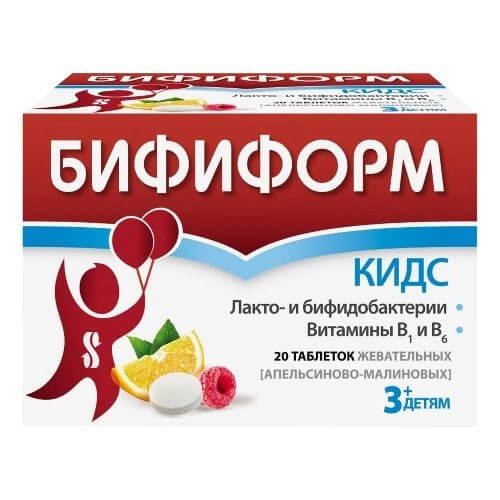

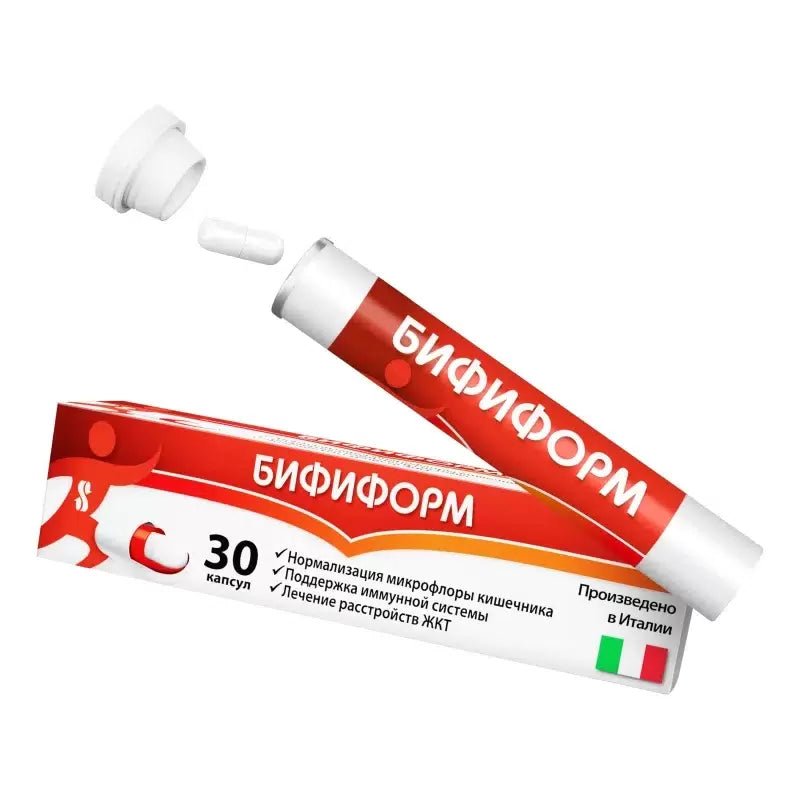

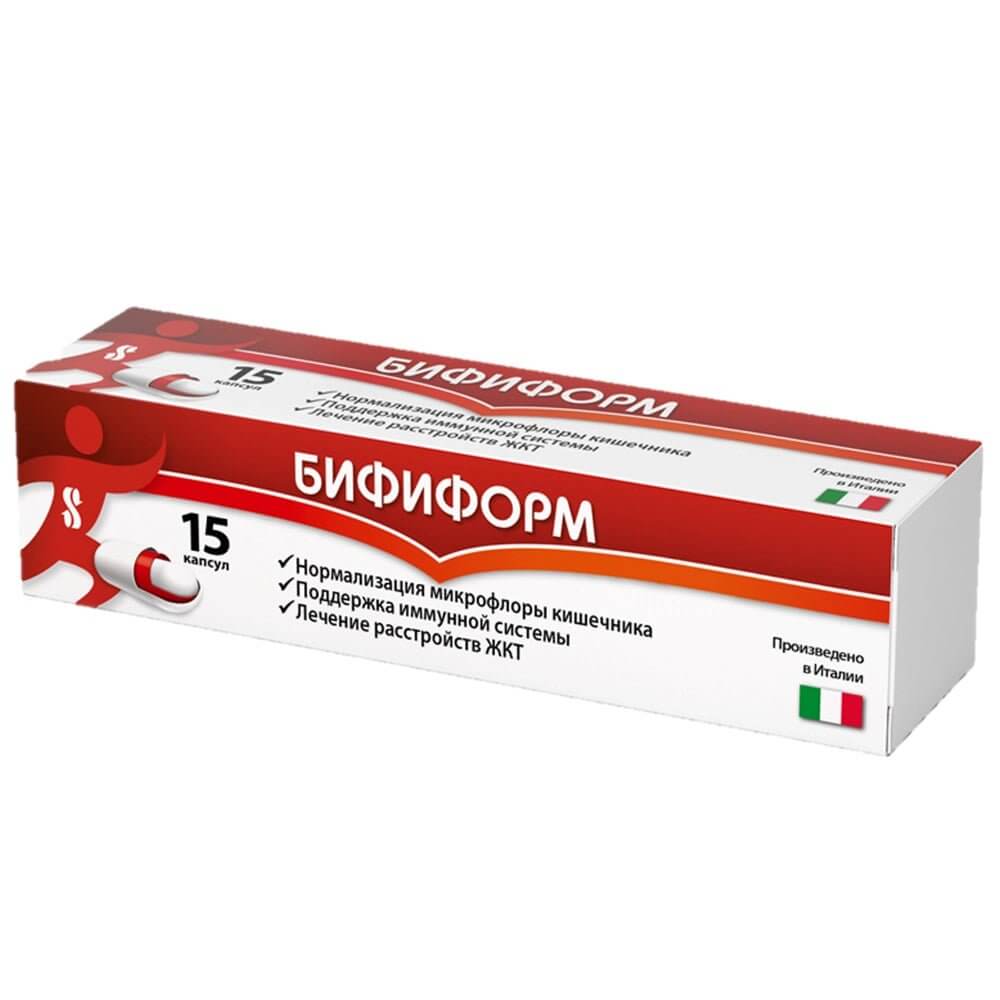

Bifiform is one of the most familiar names in the world of probiotics, a supplement of friendly bacteria that helps look after the balance of the gut. The classic adult version brings together two well-studied helpers, a Bifidobacterium and Enterococcus faecium, in a coating that carries them safely past the stomach to where they work. People reach for it to support the gut through and after an upset, to help the friendly bacteria recover after a course that has disturbed them, and simply to steady digestion through a demanding stretch. On USA Apteka the whole family is here, the adult form, drops for the littlest ones, and a children’s format, in the original packaging of European and CIS-region producers, so a returning buyer finds a name they trust.
This page is a plain-language guide, not a personal recommendation. Bifiform is a supportive probiotic rather than a fix for a diagnosed condition, and the honest way to see it is as gentle help for the gut’s own balance. The aim here is to explain what it is used for, the different forms for adults and children, how long a course tends to run, and what to know about side effects.
What Bifiform is used for and the gut
The honest way to describe what Bifiform does is to say it supports the friendly bacteria of the gut, rather than to talk about diseases it defeats. It is a probiotic for the gut, and that is its whole, useful role.
The familiar reasons people take Bifiform for the gut:
- to support the gut’s friendly bacteria through and after a bout of loose stools;
- to help those bacteria recover after a course that has knocked them back, the classic reason many keep it on hand;
- to steady digestion through travel, a change of food, or a demanding, stressful stretch;
- as gentle everyday support for people who feel their gut is easily unsettled.
A useful point on how it works: the friendly bacteria arrive in the gut and help crowd out the unwanted ones while the balance settles, which is why the effect is supportive and builds over a course rather than switching anything off at once. It is not a fix for the cause of a serious illness, so an upset with a high fever, blood, or signs of dehydration is a doctor’s matter, with a probiotic only ever a supporting part.
Forms of Bifiform: capsules, drops, and the children’s format
Bifiform comes as a small family of formats, matched to age rather than to strength, and picking the right one is mostly about who is taking it.
A quick guide to the forms:
- the adult format, Bifiform in capsules, is the coated form that carries the bacteria past the stomach, taken whole by teenagers and adults;
- Bifiform in drops is the baby format, easy to give to the littlest ones and often paired with a small oil for a measured dose;
- a children’s format, sometimes as chewables or a powder, suits older children and is the version people look up as Bifiform for kids;
- the packaging notes which format is which, so the pick follows the age on the box.
Whichever fits, the leaflet sets the amount and the schedule for that format and that age, and it is worth a read, since the baby drops, the children’s format, and the adult capsules are dosed differently.
Bifiform for children: babies and older kids
Parents often ask about Bifiform for children, including for a baby or an infant under one year, and the reassuring answer is that the family is designed with the young in mind, in age-specific forms.
A few points worth keeping in mind:
- for a baby, including an infant, the drops format is the one made for that age, given in the small amount the leaflet sets;
- for a child past the toddler stage, the children’s chewable or powder format is the usual pick;
- the adult capsules are for teenagers and adults, not scaled down for a small child;
- when a child has loose stools, fluids come first, given in small, frequent sips, with the probiotic as supportive help alongside;
- for a newborn, or for anything beyond a mild, everyday upset, a pediatrician’s word comes first.
So Bifiform for children is a familiar, age-matched choice, with the drops for babies and infants under one year and the children’s format for older kids, kept inside sensible fluid care and a low threshold for asking a doctor.
How many days Bifiform is taken
A common question is how many days to take Bifiform, and the honest answer is that it is usually a short course of a couple of weeks rather than a single day, since the friendly bacteria need time to settle in.
What the usual course looks like:
- a typical stretch runs from about a week to two or three weeks, depending on the situation;
- when it is taken to help the gut recover after a course that disturbed it, it is often continued for a stretch beyond that course, by the leaflet or a doctor;
- for an everyday digestive wobble, a shorter course is common, judged over several days;
- the exact length is set by the leaflet and the situation rather than by how quickly things feel better.
So Bifiform is not judged over a single day; it is a short, steady course. If the gut is not settling over the expected stretch, or things are getting worse, that is a reason to see a doctor rather than simply to keep going.
Side effects of Bifiform
People often look up the side effects of Bifiform, and the reassuring answer is that it is generally very well tolerated, with only a few mild, uncommon things to know.
What can occasionally show up:
- a little extra gas or bloating in the first days, as the gut adjusts, which usually settles;
- rarely, an allergic-type reaction to a component, which means stopping and checking with a doctor;
- otherwise, most people take a course with no trouble at all, which is part of why it is so widely used.
One point deserves care rather than alarm: because the adult form contains a live Enterococcus, anyone with a seriously weakened immune system, or a child who is unwell in a significant way, uses a probiotic only with a doctor’s guidance. For the ordinary, everyday user, though, the side-effect profile is mild, and a course is usually uneventful.
How to take and store Bifiform
Bifiform is simple to use, and a couple of habits help the friendly bacteria arrive in good shape.
A sensible approach:
- adults take the capsules whole with water, by the leaflet, rather than opening or chewing the coated form;
- the baby drops are given by the small measured amount the leaflet sets, and the children’s format by its own age guidance;
- it can be taken with or around food, and when it is used to help the gut recover after a disturbing course, it is often spaced a little apart from that course by the leaflet;
- some probiotic formats keep best cool, so the storage note on the pack is worth following.
The key is simply to match the format to the age, follow the leaflet, and keep the pack as its storage note advises, so the living part arrives able to do its job.
Bifiform and the season of bugs: neighboring themes
A quick honest note helps place Bifiform next to other familiar items, since the gut and general resilience overlap, but each keeps its own job.
Worth keeping in mind:
- the gut’s balance often takes a hit during and after a cold or a bug, especially when a course has disturbed the friendly bacteria, which is exactly where Bifiform helps;
- when someone chooses seasonal antiviral support, such as Arbidol, Viferon, or Ingavirin, that is aimed at the viral side of an illness and is a different tool from a probiotic;
- a probiotic supports the gut, while those seasonal options work on the illness itself, so they sit in different corners even when used around the same weeks;
- none of these replaces a doctor when an illness is heavy or a gut upset is severe.
In short, Bifiform looks after the gut’s friendly bacteria, while seasonal antiviral support works on the viral side, and the two are separate jobs that sometimes happen in the same season.
A few facts about Bifiform
A few details help place this familiar probiotic.
Worth knowing:
- the adult form pairs a Bifidobacterium with Enterococcus faecium in a coated capsule;
- the coating carries the friendly bacteria safely past the stomach to the gut;
- the family includes drops for babies, a children’s format, and adult capsules;
- its role is supportive, building over a short course rather than acting in one dose;
- the date and storage terms are printed on the pack.
Common questions about Bifiform
A few questions come up again and again, and short, honest answers help.
Quick answers:
- what is it for, supporting the gut’s friendly bacteria through an upset and after a course that disturbed them;
- how long to take it, usually about one to three weeks, by the leaflet and the situation;
- is it fine for a baby, yes in the drops format made for that age, with a pediatrician’s word for a newborn;
- capsules or drops, capsules for adults, drops for babies, and a children’s format in between;
- are there side effects, mostly none, sometimes a little gas at first, rarely an allergic reaction;
- about price and the leaflet, the cost depends on the format and pack size, and the leaflet inside sets the amount for each age.
If a question is not answered here, the support team is glad to point to the right part of the section, while the personal decision stays with you and your doctor.
Where to find Bifiform
Bifiform is available to order from USA Apteka with delivery across the United States and abroad, in the adult capsules, the baby drops, and the children’s format, in the original packaging of European and CIS-region producers, so a returning buyer recognizes the names. Delivery within the US, including Hawaii and Alaska, is free over $69, while orders to other countries ship at a paid rate regardless of the total. The support team is glad to help by chat or WhatsApp with a format or a stock check, and regular customers have a bonus program and seasonal offers.
Storage is simple, following the note on the pack, since some probiotic formats keep best cool, with the date on the box. And the sensible rule for a probiotic is to match the format to the age, run a steady short course, and see a doctor for anything more than an everyday upset, or before use in a newborn or anyone seriously unwell. Take care of yourself, and let Bifiform play its quiet, supporting part for the gut.
Please Chat with us or send us a message on WhatsApp