



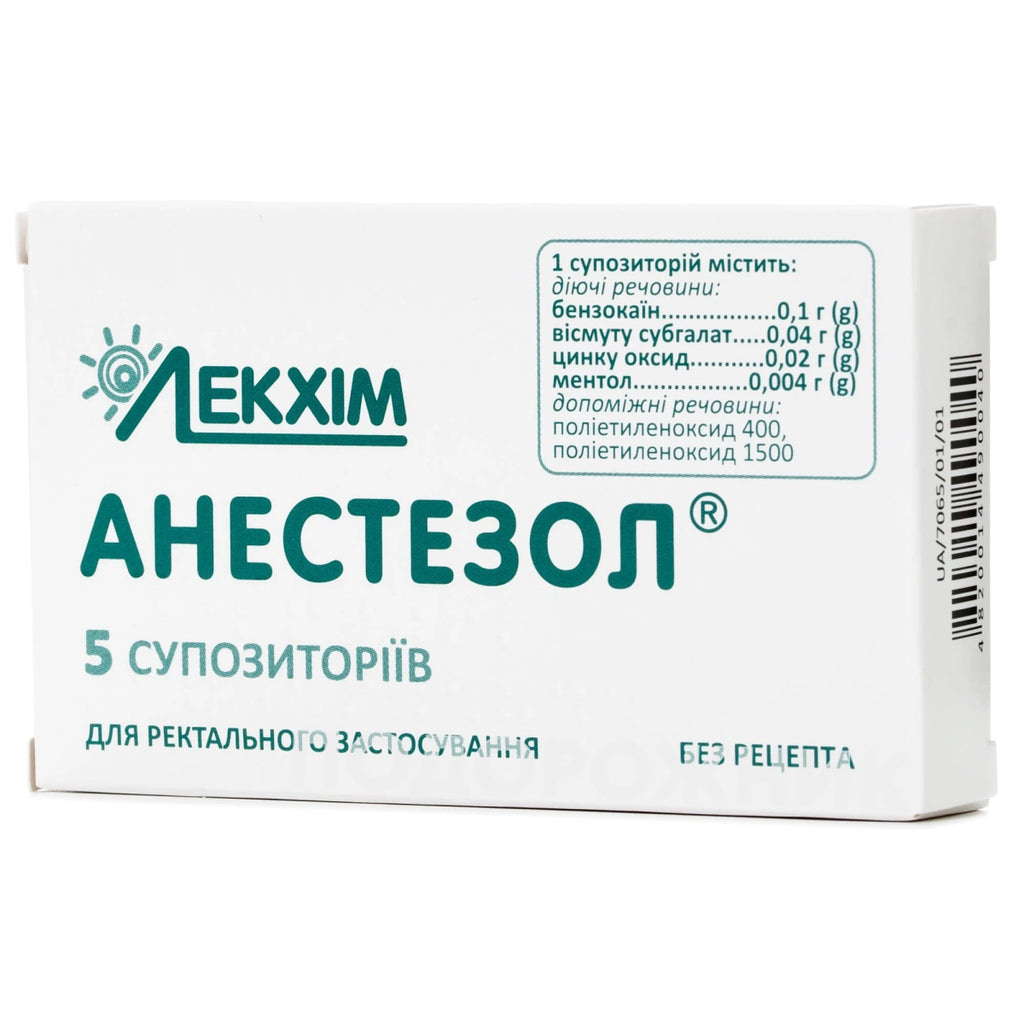


Anestezol is a rectal suppository that many Russian- and Ukrainian-speaking families know as a quick way to ease pain, burning and itching from hemorrhoids. Each suppository combines four ingredients: benzocaine, which numbs the area, bismuth subgallate, which tightens the tissue, zinc oxide, which dries it, and menthol, which gives a cooling feeling. The suppositories do not remove the cause of hemorrhoids, but they can make the first days much easier while a person changes daily habits and, if needed, sees a doctor.
This page explains what Anestezol is used for according to its leaflet, how it acts on hemorrhoids, how the suppositories are used, what side effects are possible, who should not use them, when it is time to see a doctor and how to store the pack. Each section notes when a doctor's advice is needed.
What Anestezol is used for
According to its Russian leaflet, one Anestezol suppository contains 100 mg of benzocaine, 40 mg of bismuth subgallate, 20 mg of zinc oxide and 4 mg of menthol. The leaflet lists two uses: hemorrhoids and anal fissures, which are small tears in the skin of the anal canal that hurt during and after a bowel movement.
Benzocaine has an older name, anesthesin, which is why many people still call these products anesthesin suppositories. Anestezol itself comes only as rectal suppositories. People sometimes look for Anestezol as a cream or a balm for external use, but under this name it is made only in suppository form. If a cream is needed for the outer area, it is a different product, and it is best chosen with a doctor. Suppositories with a similar set of ingredients are also sold under other names, so when comparing them, look at the active ingredients listed in the leaflet.
The first time pain, swelling or blood appears around the anus, it is worth seeing a doctor before reaching for any suppositories. Hemorrhoids are common, but similar discomfort can come from a fissure, an abscess near the rectum or other conditions of the bowel, and only an exam shows what is really going on.
How Anestezol works on hemorrhoids
Hemorrhoids are swollen veins in the lower part of the rectum and around the anus. They can hurt, itch, burn and bleed a little after a bowel movement, especially when the stool is hard and a person has to strain. Each ingredient of Anestezol addresses its own part of this discomfort:
- benzocaine is a local anesthetic, so it dulls pain and burning for a while;
- bismuth subgallate has an astringent effect: it tightens the surface of the tissue and helps reduce minor oozing;
- zinc oxide dries and protects irritated skin;
- menthol gives a cooling feeling that many people find soothing when the area itches.
The leaflet describes the combined product as having a local anesthetic, astringent and drying effect. In other words, Anestezol eases how hemorrhoids feel, while the swollen veins themselves shrink only when the pressure on them decreases. That is why the leaflet itself reminds users to keep the anal area clean, avoid straining and keep the stool soft.
NIDDK, a US government research institute that is part of the National Institutes of Health, gives similar home advice: eat more fiber, drink enough water, do not strain or sit on the toilet for a long time, and take warm sitz baths a few times a day. NIDDK also notes that suppositories and creams sold without a doctor's order can ease the discomfort, but if they do not help within about a week, it is time to see a doctor.
How to use Anestezol suppositories
According to the leaflet, Anestezol is used rectally after a bowel movement or a cleansing enema. Adults and children older than 12 years use 1 suppository once or twice a day. The leaflet does not set a course length, but it says to see a doctor if the discomfort does not ease during use or if new, unusual sensations appear.
A few practical steps make the procedure easier. Wash your hands, take the suppository out of its wrapper and insert it gently, pointed end first, while lying on your side with the upper knee bent toward the chest. Stay lying down for a few minutes so the suppository can melt. If it has become soft in a warm room, put it in the refrigerator in its wrapper for a few minutes before use. Wash your hands again afterward. Many people use the suppository at night and wear a thin panty liner to protect their underwear.
Suppositories are only for rectal use and are never swallowed. If a child has swallowed one, call Poison Control at 1-800-222-1222 or your doctor right away: benzocaine is especially risky for young children.
What helps alongside the suppositories
Suppositories work best together with simple changes in daily habits. NIDDK lists the main reasons hemorrhoids appear or get worse: straining during bowel movements, sitting on the toilet for a long time, constipation or diarrhea that lasts long, a diet low in fiber, pregnancy and lifting heavy objects. Much of this can be eased at home:
- go to the bathroom when you feel the urge, and do not stay there with a phone or a book;
- a small footstool under the feet raises the knees and makes bowel movements easier;
- add vegetables, fruit, whole grains and beans to meals little by little, and drink water through the day;
- after a bowel movement, rinse the area with water or use soft wipes without fragrance or alcohol;
- choose loose cotton underwear and avoid lifting heavy things while the discomfort lasts.
If hemorrhoids come back often despite these habits, a doctor can suggest other options, from creams to small procedures done right in the office.
Side effects of Anestezol
The leaflet lists possible side effects: burning in the rectum, a laxative effect and allergic reactions. A short burning sensation right after insertion can happen, but strong or lasting burning, a rash, itching all over the body or swelling are reasons to stop using the suppositories and talk to a doctor.
The leaflet also mentions isolated reports of methemoglobinemia with products that contain benzocaine. In this condition, the blood carries less oxygen than it should. MedlinePlus, the consumer health service of the US National Institutes of Health, describes its signs: a bluish color of the skin, lips or nails, headache, tiredness and shortness of breath. These signs need emergency care, so if they appear after using any product with benzocaine, call 911. In 2018, the FDA warned that benzocaine products for teething pain should not be given to children under 2 because of this risk, which is one more reason to keep the pack out of children's reach.
The leaflet does not describe interactions with other products, and it notes that Anestezol does not affect the ability to drive. Even so, if you take other products every day, especially for the heart or blood, tell your doctor about the suppositories.
Who should not use Anestezol
According to the leaflet, Anestezol is not used:
- by children under 12 years;
- by anyone who has reacted to benzocaine, bismuth subgallate, zinc oxide or menthol.
During pregnancy and breastfeeding, the leaflet allows Anestezol only with caution, when the expected benefit for the mother outweighs the risk for the baby. Hemorrhoids often appear during pregnancy, as NIDDK notes, so this question comes up often. The decision is best made with the obstetrician, who can also suggest other ways to ease the discomfort.
People who have had a reaction to local anesthetics before, for example at the dentist, should also mention it to a doctor before using Anestezol.
When to see a doctor
NIDDK advises seeing a doctor if hemorrhoid discomfort does not improve after a week of home care, and also whenever there is bleeding from the rectum, because blood can be a sign of other conditions of the bowel. If the bleeding is heavy, or comes with dizziness, lightheadedness or fainting, NIDDK advises getting medical care right away.
Other reasons to see a doctor without delay are severe pain that makes it hard to sit, a hard, painful lump near the anus, black or maroon stool, a high temperature, and hemorrhoids that come back again and again. A doctor can examine the area, explain what is causing the discomfort and suggest other options if suppositories are not enough.
How to store Anestezol
According to the leaflet, Anestezol is stored in a dry place protected from light, at a temperature no higher than 20°C (68°F), out of children's reach. It keeps for 3 years and is not used after the date has passed. Because the suppositories soften in warmth, many people keep them in the refrigerator, especially in summer, and the product description on our website also advises putting the pack in the refrigerator right after the order arrives. If the suppositories have melted and lost their shape, or the date has passed, they are not used. If you are unsure, ask your doctor.
Other products that may be useful alongside Anestezol
Products for delicate situations are usually kept in one box, away from curious eyes, and Anestezol rarely sits there alone. Here is what often ends up next to it, from a syrup for constipation to a powder for a cold evening.
- Duphalac is a lactulose syrup for constipation that makes the stool softer. Since hard stool and straining are among the main reasons hemorrhoids flare up, the syrup is often kept next to suppositories. It contains a small amount of lactose and galactose, and if changes in the stool last long or blood appears, it is time to see a doctor.
- Benzyl benzoate is an emulsion and balm for scabies, used strictly according to its leaflet. Scabies itch usually gets worse at night, and it is a doctor who confirms scabies and decides whether everyone in the family should use the product at the same time.
- AntiGrippin is a powder for a hot drink with paracetamol, chlorphenamine and vitamin C that adults take for aches and a raised temperature during cold season. It can make a person sleepy and is not combined with other products that contain paracetamol. If a high temperature lasts more than 3 days, a doctor is needed.
- Anestezol itself is there for hemorrhoids and anal fissures, used according to its leaflet and not for children under 12.
The right set depends on the family and its health, and none of these products replaces a doctor when discomfort is strong or lasts long.
Where to find
Anestezol rectal suppositories can be ordered from USA Apteka, a Russian and Ukrainian store in the US, and the whole selection is on this page. Delivery within the US, including Hawaii and Alaska, is free over $69, while orders to other countries ship at a paid rate regardless of the total. The care team answers questions about the products or delivery in the chat on the website or on WhatsApp, and regular customers have a bonus program and seasonal sales.
Read the leaflet before use, keep the suppositories out of children's reach, and see a doctor if the discomfort does not ease within a week or if there is any bleeding.
Please Chat with us or send us a message on WhatsApp