



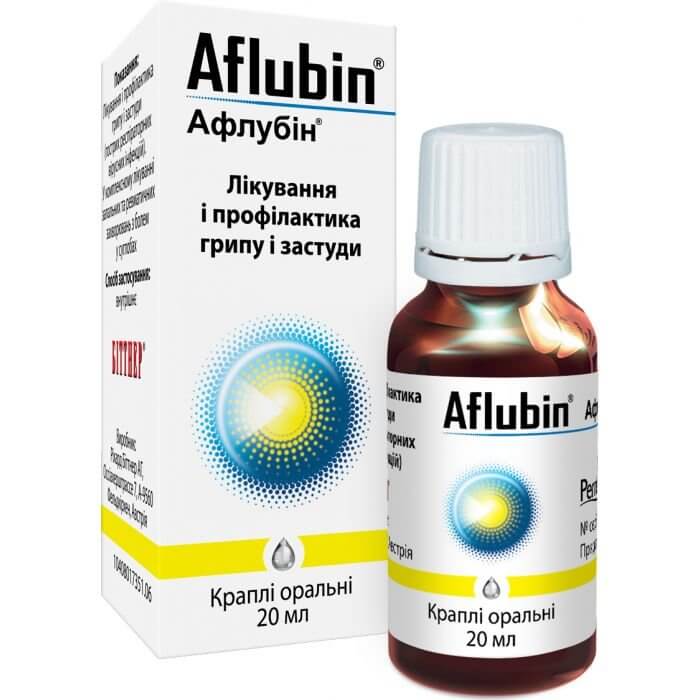

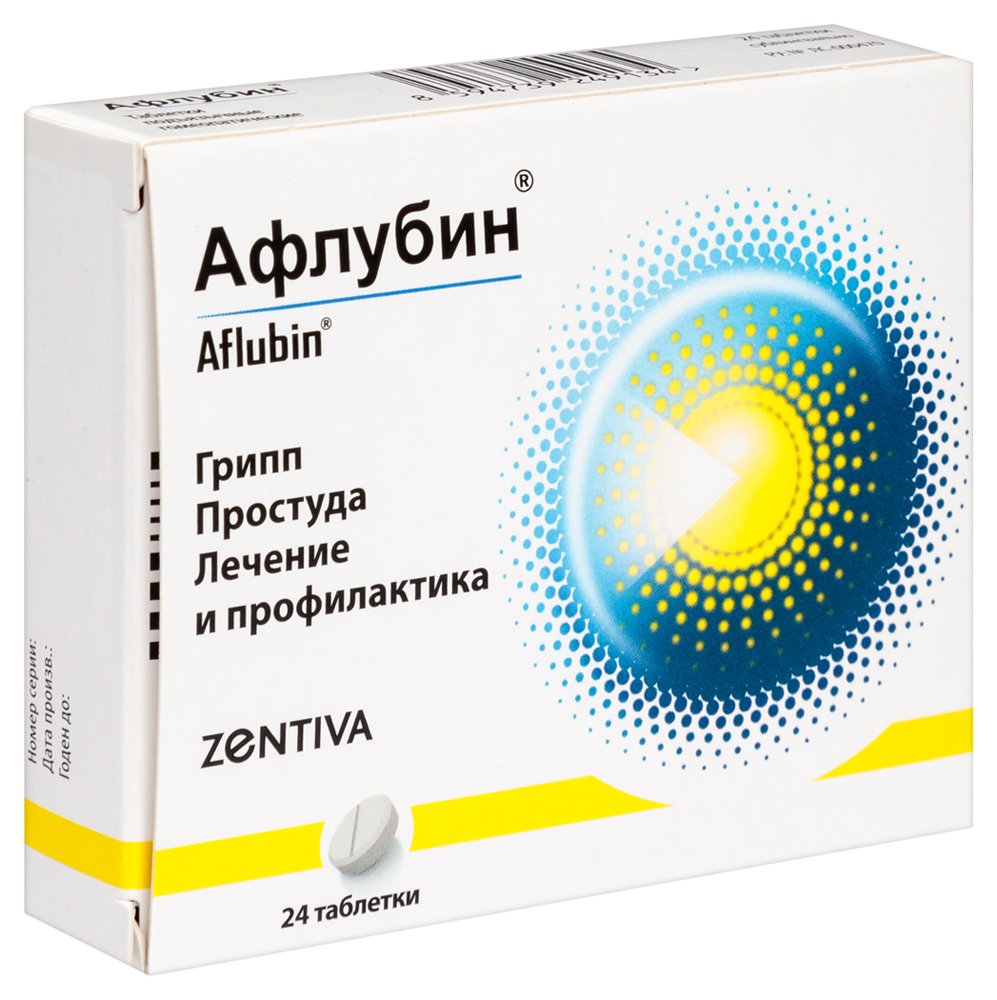

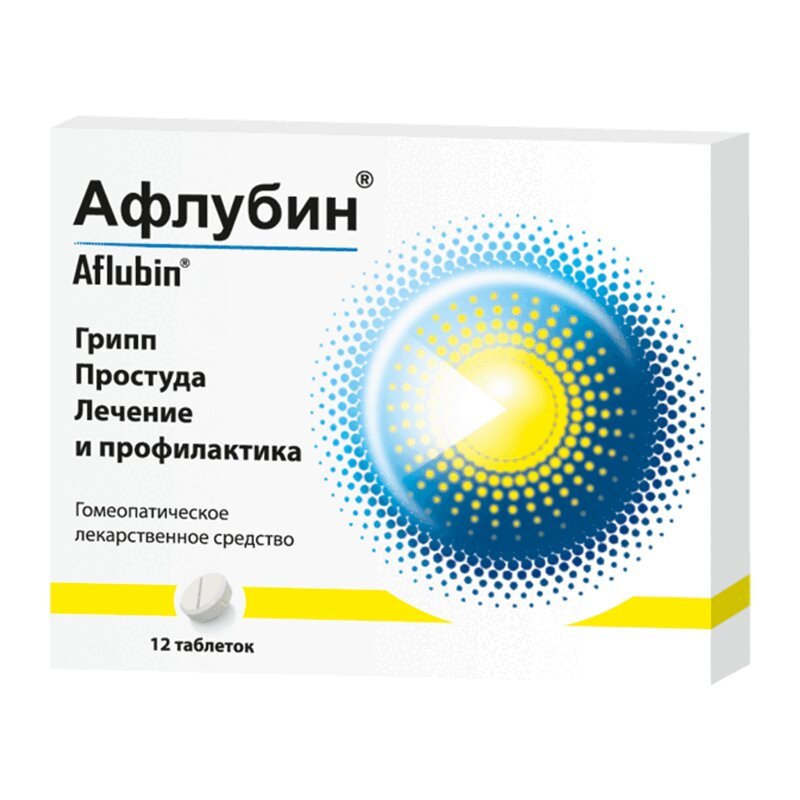

Aflubin is a homeopathic product from an Austrian manufacturer, a name that households across Russia, Ukraine and the wider CIS region have known for decades. It comes in two forms: oral drops, counted into a little water, and small tablets that dissolve under the tongue. Both carry the same declared makeup, a set of homeopathic dilutions of gentian (Gentiana), aconite, bryonia, iron phosphate and lactic acid. In its home markets it is positioned for the early days of a seasonal cold and for a course through the cold months.
What follows covers five things: what a homeopathic dilution actually is, how the drops and the tablets differ in daily practice and why the alcohol base of the drops matters, what the manufacturer’s instructions describe for a seasonal course, what is known and what is not known about pregnancy, and the situations where a doctor comes before any of this. None of it is a recommendation to start taking anything.
What a homeopathic dilution is, stated plainly
A homeopathic dilution and a working amount of an active ingredient are two different things, and that difference is the whole point of this section. The plants and minerals named on the box are real enough as names - gentian, aconite, bryonia, iron phosphate, lactic acid - but they are present as homeopathic dilutions, which means quantities far below what would act on the body the way an ordinary active ingredient does. Reading that component list and picturing a spoonful of gentian would be a misreading of the label.
The second part matters just as much. The evidence for homeopathy in seasonal colds is weak and contested. Reviewers who have gone through the published work disagree with one another, and nothing in that body of work supports a claim of proven effect. Which is why this page will not say that Aflubin strengthens anything, shortens a rough few days, works against a virus, or holds off a seasonal bug. Those sentences turn up constantly in casual conversation about this product, and not one of them can be defended.
Aflubin is a long-familiar homeopathic remedy with a tradition of use across the CIS region, reached for by many people out of habit and family practice, the way a household keeps doing what it has always done when the weather turns. The schedule for taking it comes from the manufacturer’s instructions in the box, not from anyone’s advice online and not from this page. Homeopathy does not replace a doctor’s care, and anything beyond a mild seasonal ailment is a reason to see a doctor rather than to keep counting drops.
Drops or tablets: how the two forms differ in practice
The declared makeup is the same in both forms, so choosing between them is a question of convenience and of one concrete limit.
The drops carry an alcohol base. Ethanol is part of the drops, and that single fact explains most of the practical rules around them. The drops are avoided during pregnancy. They are not suitable for anyone living with alcohol dependence. They are a genuine consideration for drivers, and for a parent deciding what to give a small child. None of that is a warning invented for this page; it follows directly from what is in the bottle.
At the same time, the drops are counted into a little water, and per the leaflet this is the form usually used for small children, precisely because the amount can be scaled down to a few drops. Both things are true at once, which is exactly why the leaflet and a pediatrician, rather than a rule of thumb picked up from a neighbor, settle the question for a young child.
The tablets are the alcohol-free option. They dissolve under the tongue, need no water and no spoon, and travel well in a bag or a coat pocket, which is why plenty of adults end up preferring them. For anyone who would rather not have ethanol in the picture at all, the tablets answer the form question directly. The trade-off runs the other way too: holding a tablet under the tongue asks something of a very young child that a few drops in water does not.
The short version of the form question, then. Drops where a small, flexible amount is wanted and where the leaflet points to them, with the alcohol base kept firmly in mind. Tablets for portability and for anyone steering clear of alcohol. And where pregnancy, a small child, driving or alcohol dependence is part of the picture, the choice belongs with a doctor rather than with the shelf.
A course through the cold season: what the manufacturer’s instructions describe
The leaflet inside the box describes a course that runs for a set number of weeks through the cold months, generally begun before or at the very start of the season rather than partway through a bad week. The exact figures, meaning how many drops or how many tablets, how often, and how many weeks, are printed there and differ by age and by form. Inventing those numbers on a shop page would be worse than useless, so they are not here.
What a course is not deserves its own sentence. A schedule is a schedule. It is not protection, and nothing about taking a homeopathic remedy through the winter should be read as holding off a seasonal bug or as a substitute for anything a doctor would suggest. The leaflet allows for a seasonal course; it does not promise an outcome, and neither does this page.
A course also has an end date printed in the instructions. Stretching it indefinitely because the season feels long is not what the manufacturer describes, and a product taken out of pure momentum stops being a course and becomes a habit nobody chose.
The things that genuinely carry weight through the cold months are ordinary and unglamorous: sleep, fluids, washing hands, airing out rooms, dressing for the actual weather, and whatever seasonal preventive steps a doctor recommends for a particular person with a particular history. Anyone starting a seasonal course alongside products they already take regularly, or with a long-term condition in the background, raises it with their doctor before day one rather than after week three.
Aflubin during pregnancy: why this one belongs with a doctor
There is no adequate safety data for Aflubin in pregnancy. That sentence is the foundation of everything else in this section, and it is worth sitting with for a moment, because an absence of data is not the same thing as a clean record. No one can give a confident answer to a question that was never properly studied.
The manufacturer does not settle it either. The leaflet defers to a doctor, and that deferral is a signal rather than a legal formality. When the people who make a product decline to give a general answer, a shop page is in no position to improve on them.
The alcohol base of the drops adds a second, entirely separate argument. Ethanol during pregnancy is not a question anyone wants to answer casually, and the drops contain it. That on its own moves the drops out of the self-decided category, whatever the amount in a few drops turns out to be. The tablets sidestep the alcohol part of the problem, but not the missing-data part.
There is also a familiar line of reasoning worth naming: it is homeopathic, so it cannot do any harm. That does not work as an argument in either direction. Whatever a person concludes about the strength of a homeopathic dilution, the reasoning that makes it harmless is the same reasoning that makes it inactive, and neither conclusion is a substitute for a doctor who knows this particular pregnancy. The same conversation covers nursing.
So the full defensible answer is short. No adequate data, a manufacturer who defers to a doctor, alcohol in the drops, and a decision made with a doctor before the first day rather than after it. And a cold during pregnancy is itself worth a doctor’s eye, separately from the question of what is in the cupboard.
When drops and tablets are beside the point and a doctor comes first
A homeopathic remedy sits at the very mild end of what a household reaches for, and that placement carries a consequence: there are plenty of situations where it is simply not the thing being discussed.
A temperature that climbs, or holds for more than a couple of days, belongs with a doctor. So does trouble breathing, shortness of breath, chest pain, a severe headache, confusion, or a state that keeps getting worse instead of slowly leveling out. The same goes for a small child, an older adult, a pregnancy, a long-term condition in the background, or anyone whose defenses are already lowered for reasons a doctor is tracking.
The risk with a familiar, gentle, long-trusted remedy is not the remedy. It is the waiting. Finishing a course before calling anyone is a real pattern, and it costs days that occasionally matter. Homeopathy does not replace a doctor’s care, and a course is never a reason to postpone a phone call.
One more practical note. Anyone already taking something regularly, or managing a condition under supervision, mentions the seasonal course at the next appointment rather than deciding alone that a homeopathic product is too mild to be worth mentioning. Doctors would rather hear about it.
Neighboring themes
Three neighboring pages in this section sit near Aflubin for no reason of composition at all. What separates them is the occasion. Aflubin belongs to the cold months, two of the three belong to an evening when the mind will not settle, and the third belongs to a table with too much food on it.
- Valerian belongs to the restless evening: a plant remedy people reach for after a long day, with nothing to do with the season or the weather.
- Novo-Passit is calming as well, and it makes a useful contrast here, because it is a plant blend in ordinary amounts rather than a set of homeopathic dilutions. Two very different logics behind a similar purpose.
- Mezym is the heavy-meal one: enzymes doing their work in digestion, a different system of the body entirely and a different occasion.
None of the three stands in for another, and none of them removes the need for a doctor when what a person feels goes past a mild seasonal ailment or the aftermath of a large dinner.
Where to find
Aflubin is available to order from USA Apteka with delivery across the United States and abroad, in drops and in tablets, in the original packaging of its European producer. Delivery within the US, including Hawaii and Alaska, is free over $69, while orders to other countries ship at a paid rate regardless of the total. The support team is glad to help by chat or WhatsApp with choosing a form or checking stock, and regular customers have a bonus program and seasonal offers.
Storage is simple: a dry place away from direct sunlight, the bottle closed, with the date printed on the box.
Before starting, and particularly during pregnancy, for a child, or alongside anything taken regularly, the decision belongs with your doctor. This page is supporting reference material and does not stand in for the leaflet inside the box.
Please Chat with us or send us a message on WhatsApp