


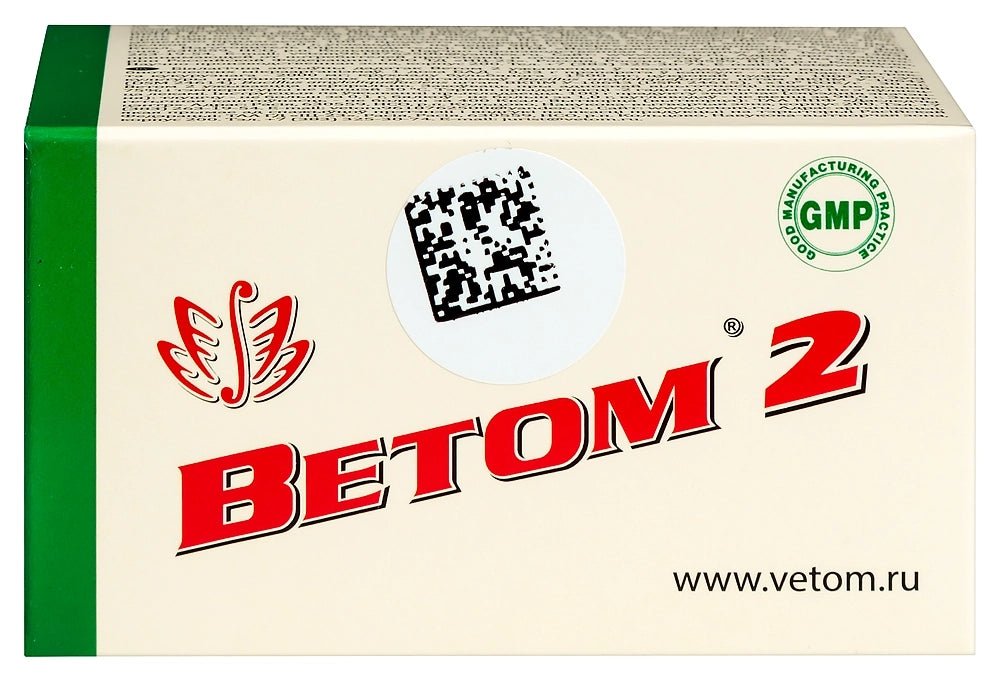

Vetom is a Russian-made line of dietary supplements built on spore-forming bacteria of the Bacillus subtilis group, with some products in the line based on Bacillus amyloliquefaciens instead. It is supplied as a fine powder that is stirred into water and as capsules, and every pack carries a number beside the name: Vetom 1, Vetom 1.1, Vetom 2, Vetom 3, Vetom 4 and so on. In its home market the whole line is registered as a dietary supplement and not as a medicine, and that distinction is the first thing worth fixing in mind before anything else is discussed.
What follows explains what those numbers stand for, what people usually take the line for, who should not start it without a doctor’s approval, and how the powder is handled so that the live cultures reach the glass intact. The leaflet inside the box stays the source for amounts and schedule, and any question about a particular person, their age or their state of health belongs with that person’s doctor.
What Vetom is taken for
Vetom belongs to the family of spore probiotics, and the way it is used follows from that. In its home market the line has a long run of popular use as everyday digestive support, and the manufacturer’s instruction describes short courses with a beginning and an end rather than something swallowed indefinitely. The reasons people reach for it are ordinary ones.
The familiar reasons:
- as supportive care for digestive comfort, when things feel heavy, noisy or simply out of rhythm;
- during or after a course of antibiotics, which is the single most common reason a jar ends up in a basket;
- through a change of water, food and routine, such as a long trip or a move to a new country, when eating habits shift faster than the gut does;
- as a defined course, following the schedule printed on the pack;
- alongside plain habits that count for at least as much: regular meals, enough water, sleep and movement.
What matters equally is what the line is not. The claims made for spore probiotics as a group are not the same thing as proven benefits for this particular supplement, and the careful way to describe Vetom is traditional and popular use plus the manufacturer’s instruction. It does not remove toxins from the body, it does not rebuild immunity, and it does not resolve a gut condition; anything phrased as a promise to fix something has moved from fact into advertising. Whether a supplement has any place next to everything else a person already takes is a question for their doctor.
What the numbers on the pack mean
The numbering is where most buyers stumble, and the stumble is understandable: the numbers look like strengths and are not. Vetom 1, Vetom 1.1, Vetom 2, Vetom 3 and Vetom 4 denote different strains or different combinations of strains, not different doses of one and the same thing.
Worth knowing about the naming:
- a higher number does not mean a stronger product, and Vetom 4 is not four times anything;
- Vetom 1.1 is the best known name in the line, which is why it surfaces first in search and why most people have heard of it;
- powder and capsules are two formats of the same idea, and the choice between them is about convenience rather than effect;
- the manufacturer also produces a veterinary line under the same brand, with names that look almost identical at a glance;
- which product is intended for people is stated on the pack itself, and the pack is what settles the question.
That veterinary line is the reason the phrase “for people” turns up in search so often. Buyers simply want to be sure they picked up the human version, and the answer is plain: the human and veterinary products are separate items with separate packaging, and reading the box before paying takes a few seconds. If a pack arrives unlabeled, relabeled or without its leaflet, it is better set aside, and the seller’s support team can confirm what was actually sent.
How safe Vetom is for people
For most healthy adults a spore probiotic is generally well tolerated, and the complaints that do come up are mild and early: a few days of bloating, more gas than usual, or a change in stool while the gut adjusts. Those usually settle on their own. The serious part of the answer concerns a smaller group of people, and it is not a formality.
Where a live-culture product needs a doctor’s approval first:
- anyone with weakened immunity;
- the same applies to anyone undergoing chemotherapy;
- and to anyone with a central venous catheter or another indwelling line;
- and to anyone who is seriously ill, including anyone in the hospital, because any product containing live microorganisms carries a small but real risk in these situations;
- children, pregnancy and breastfeeding, where a doctor decides.
One more line belongs here, and it is the one most easily skipped. A dietary supplement does not stand in for medical care. Digestive trouble that keeps going, a fever, blood in the stool, or weight loss nobody planned are reasons to see a doctor without waiting for the course to end. The same holds for any reaction that appears after the first jar and does not fade within the first days: the course is stopped and a doctor is asked.
Which Vetom suits the gut
No article can say which product in the line suits a particular person’s gut, and none could: the line differs by strain rather than by strength, so there is no scale running from mild to powerful along which a person can be placed.
What actually helps the choice:
- the pack and the manufacturer’s instruction state which product is intended for which purpose, and that is the primary source;
- a pharmacist or doctor can match a strain to a person, taking in age, state of health and everything else being taken that week;
- the veterinary products in the same brand family carry similar names, which makes a careful look at the box part of the decision;
- one product at a time, in a single defined course, is far easier to judge than two or three started together;
- if a course brings nothing at all, asking a doctor why is more useful than adding a second product.
For a first purchase the practical route is to take the name a doctor or pharmacist mentioned, or the one the instruction describes for the purpose in question, and to finish a single course before drawing any conclusion. And if the digestive trouble behind the purchase has been running for a long time, the place to start is a doctor’s appointment, which no choice of strain replaces.
How the powder and capsules are taken
Handling counts for more here than with an ordinary supplement, because the whole point is a live culture that has to survive the journey from jar to glass.
The practical side:
- the powder is dissolved in water at the temperature the instruction states, and hot water is avoided because heat damages live cultures;
- the leaflet usually separates the dose from meals in time, and the written schedule is the one to keep to;
- capsules are swallowed whole with water, and choosing between capsules and powder is a matter of convenience;
- the expiry date and the storage conditions are printed on the pack and are worth reading, since live cultures are not indifferent to warmth and damp;
- the jar is kept closed, dry and out of direct sun, and a portion is mixed fresh rather than left standing on the counter.
A missed day is not made up with a double dose, and one jar is not stretched across three months of irregular use. If the schedule is hard to keep, a doctor may have a simpler suggestion.
Neighboring themes
Each of these ends up in a home kit for its own reason, and it helps to know what each one is there for, especially since they sit next to Vetom in different ways.
- Activated charcoal is kept for an upset stomach after questionable food: it binds whatever it meets in the gut and carries it out. Next to Vetom it has one catch: charcoal binds live cultures too, so the two are spaced a couple of hours apart.
- Valerian is in the kit for a restless evening when sleep will not come. It has nothing to do with digestion, and it is taken at a different hour from Vetom simply because the two have different jobs.
- Arbidol turns up in the kit for the cold season as an antiviral. It does not overlap with Vetom: one works on the virus, the other supports the gut, and through the same cold they do not get in each other’s way.
Vetom itself is kept for the times digestion has been thrown off: after antibiotics, on a trip, with a change of diet. It is a supplement taken as a course, not a one-off remedy.
A home kit is put together for the household that uses it, and there is no correct set. When several of these land on the same day, the spacing between them is a fair question for a doctor or a pharmacist.
Where to find
Vetom is available to order from USA Apteka with delivery across the United States and abroad, as a powder and as capsules in the original packaging of the producer, so a returning buyer recognizes both the jar and the numbering on it. Delivery within the US, including Hawaii and Alaska, is free over $69, while orders to other countries ship at a paid rate regardless of the total. The support team is glad to help by chat or WhatsApp with choosing a pack and checking stock, and regular customers have a bonus program and seasonal offers.
Vetom is a dietary supplement rather than a medicine, and it does not stand in for a doctor’s care. If anything about digestion is persistent or worrying, that appointment comes first.
Please Chat with us or send us a message on WhatsApp