



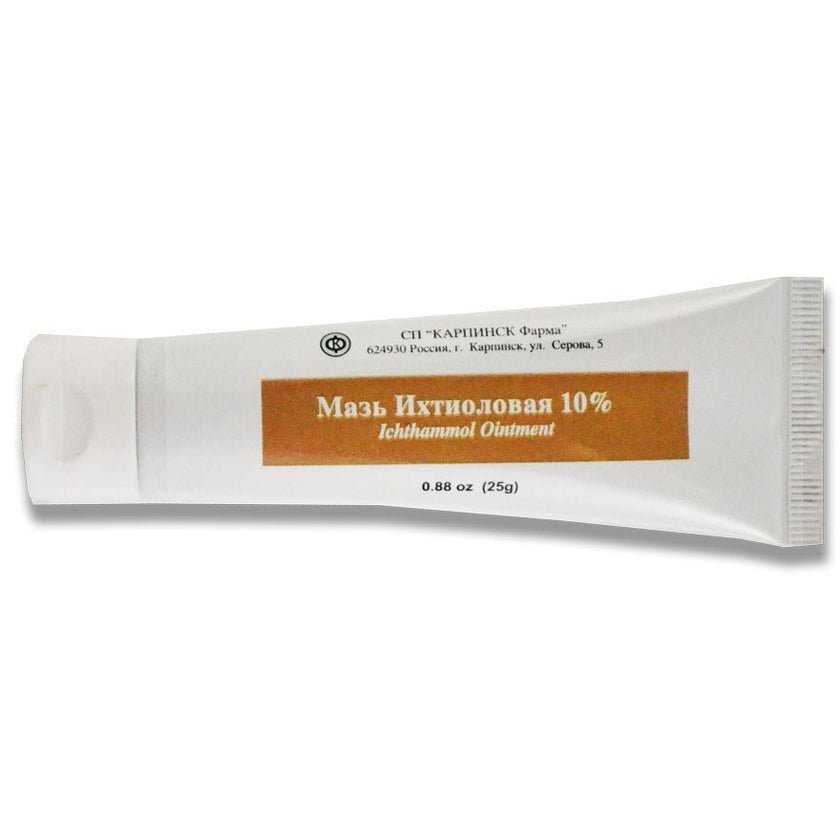
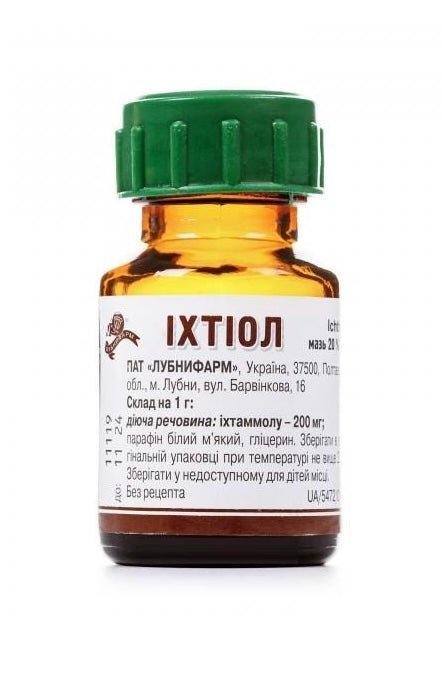


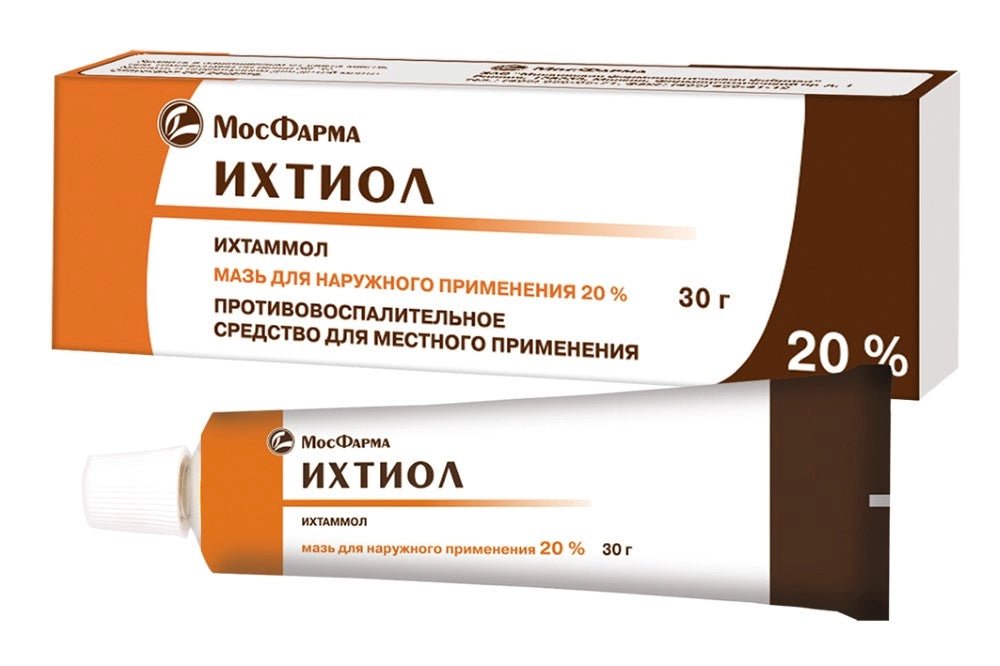

Ichthyol balm is the thick black product with a sharp tar smell that many people remember from childhood: a dab on a painful red bump, a square of gauze on top, and a smell that stayed in the room for a day. At home it was often called the drawing balm, because it went on a boil to help it come to a head. Its key ingredient is ichthammol, also known as ichthyol or ammonium bituminosulfonate. Ichthammol is obtained from sulfur-rich oil shale, and Russian manufacturers make it into a 10% or 20% balm for the skin and into suppositories.
It is a product with more than a century of use behind it, and its limits are as worth knowing as its uses. The sections below cover what the leaflet says ichthyol balm is for, why people reach for it with pimples and sore joints, how to apply it and who should not use it, how the 10% and 20% balms and the suppositories differ, and which boils belong in a doctor's office rather than under a home bandage.
What ichthyol balm is used for: boils, pimples and joints
The Russian leaflet describes ichthyol balm as a soothing product for local use with several effects at once. Ichthammol acts against Staphylococcus aureus and Streptococcus pyogenes, two germs that often live on the skin, softens and evens out the rough top layer of the skin, and dulls local pain: on contact it first slightly irritates the nerve endings and then lowers their sensitivity. The leaflet also says that it speeds up the ripening of boils, the painful, pus-filled bumps that form around a hair follicle.
MedlinePlus, the US government health library, describes how a boil usually develops: it starts as a tender, pinkish-red, swollen spot on a firm patch of skin, then grows and fills with pus until a white or yellow center appears. It can be anywhere from the size of a pea to the size of a golf ball, and the pain grows as pus builds up and eases once the boil drains.
For the skin, the leaflet lists the following situations, always as part of combined care:
- erysipelas, a fast-spreading bacterial skin condition with red, hot, swollen skin and often a high temperature;
- eczema;
- pyoderma, the general name for skin conditions with pus, including furunculosis, when boils appear one after another;
- for the 20% balm, the leaflets of some manufacturers also mention the stable stage of psoriasis.
Erysipelas and repeated boils are conditions that a doctor manages, usually with products taken by mouth, and the balm only joins that care. The FDA has not recognized any store-bought product, ichthammol included, as proven safe and effective for shrinking boils, which is one more reason to see the balm as a helper alongside the main care.
Whether ichthyol helps with pimples is one of the most common questions. Acne is not on the list in the leaflet, and there are no good studies showing that ichthammol clears it. Some people put a thin layer on a single deep, sore pimple that behaves like a small boil and leave it overnight under a bandage. On the face, the balm is used carefully: it stains, smells and can irritate delicate skin. For acne that keeps returning, a dermatologist can suggest products that have actually been studied for it.
Rubbing ichthyol balm into a sore knee is another family habit. The current Russian leaflet does not name joint pain among its uses, and there is no evidence that ichthammol helps joints. A joint that is swollen, red or hot, or pain that lasts more than a few days, needs a doctor, ideally a rheumatologist.
How to apply ichthyol balm: directions, frequency and who should not use it
According to the product card, the balm is applied in a thin layer to the affected skin once or twice a day, with a bandage if needed. How many days to continue, for adults and for children alike, is agreed with a doctor. A few practical details make that short instruction easier to follow:
- the skin around the spot and the hands are washed first, and the balm is taken out with a cotton swab or a clean spatula rather than a finger;
- a thin layer is enough, and a thick one only stains more;
- a square of gauze or a nonstick pad fixed with tape keeps the balm in place and protects clothes; the bandage is changed at least once a day;
- ichthammol leaves dark marks on fabric, so old clothes and an old pillowcase help; the balm washes off the skin with warm water and soap.
The balm is kept away from the eyes and mucous membranes. The leaflet also names substances it does not mix with: iodine salt solutions, alkaloids, heavy metal salts and zinc oxide. In practice this means that ichthyol is not put right on top of zinc balm or on skin just painted with iodine.
Who should not use it, according to the leaflet:
- people sensitive to ichthammol;
- children under 12, for use on the skin;
- anyone under 18, for the suppositories;
- skin with broken surface, such as an open wound.
During pregnancy and breastfeeding, ichthammol is used only after talking to a doctor. Side effects are uncommon, mainly allergic reactions, and the suppositories can cause a burning feeling. If redness, itching or a rash appears around the spot, the balm is washed off and not used again, and a reaction that does not settle is shown to a doctor.
MedlinePlus adds two pieces of advice for a boil at home: warm, moist compresses several times a day help it drain, and a boil should never be squeezed or cut open at home, because that can spread the germs deeper.
Once a boil opens on its own, the leaflet's warning about broken skin applies, and ichthyol is no longer put on the open spot. MedlinePlus advises continuing warm, wet compresses after the boil opens, keeping it clean, changing the dressing often and throwing used dressings away in a sealed bag so that the fluid does not touch anything else. If the opening does not start to close over the next few days, or the redness around it grows, a doctor should look at it.
Ichthyol balm 10% and 20% and ichthyol suppositories
Ichthyol comes in a few forms, and the difference between them is about strength and the area they are meant for:
- 10% balm, in 25 g and sometimes 30 g packs: 1 g contains 100 mg of ichthammol;
- 20% balm, in 25 g and 30 g packs, twice as concentrated;
- rectal suppositories with 200 mg of ichthammol, in packs of 10, used only for the conditions named in their own leaflet and only on a doctor's advice.
A stronger balm is not automatically a better one. It is more likely to irritate, and the concentration for a particular spot, especially on the face or in a child over 12, is best chosen with a doctor. The suppositories have nothing to do with the skin: their leaflet lists conditions of the pelvic organs, in women and in men, as part of combined care, and those conditions are always managed by a gynecologist or a urologist.
On USA Apteka, ichthyol balm is sold in 10% and 20% concentrations in 25 g packs, the 30 g packs appear when they are in stock, and the suppositories of 200 mg come 10 to a pack. Balms and suppositories are shipped in a thermal bag with dry ice, and at home they are stored as the leaflet asks, out of children's reach, with the cap closed so the smell stays inside.
When a boil needs a doctor
Most small boils open and clear up on their own within about two weeks, but some need a doctor from the start. MedlinePlus advises contacting a health care provider if a boil:
- appears on the face or on the spine;
- comes with a high temperature, red streaks spreading from the sore, a large buildup of fluid or other signs of infection;
- is painful;
- does not get better with home care within a week;
- comes back after care.
Red, hot, quickly spreading skin with a high temperature and chills may be erysipelas, and it needs a doctor the same day. Several boils that join into one large, painful area also need a doctor. While a boil is getting better, MedlinePlus recommends washing hands before and after touching it, changing the bandage often, keeping a separate towel and washing towels and sheets in hot water. A boil in a baby, in an older person or in someone with diabetes is a reason to call a doctor sooner rather than later.
Ichthyol balm usually sits with the bandages and tape, while the three neighbors below are tablets and suppositories, and each of them meets the balm in its own way.
- Validol is a small menthol tablet placed under the tongue at a nervous moment or with mild discomfort in the chest. A painful boil can keep a person awake and on edge, and validol may help someone settle down, but it does nothing for the boil itself. Pain or pressure in the chest that does not pass within a few minutes is a reason to call 911.
- Citramon combines aspirin, paracetamol and caffeine and is kept for a headache. People sometimes take it when a boil throbs. It can ease the pain for a while, but it does not combine with other products that contain paracetamol, it is not given to children and teenagers, and it is hard on the stomach. If a boil hurts enough to need tablets, it is worth showing it to a doctor.
- Viferon is a product with interferon, registered in Russia for viral conditions, and it comes as suppositories, a gel and a balm. Its suppositories look much like ichthyol suppositories in a drawer, so it helps to keep the boxes apart and to check the label each time. Each is used only for what its own leaflet describes, and Viferon for a child is used on a pediatrician's advice.
Ichthyol balm itself is there for the moment a boil starts to swell, and for that moment it is kept closed, cool and out of children's reach.
What goes into a kit depends on the family and on the problems it usually meets. None of these products replaces a doctor, and a boil that grows, hurts more or comes back is worth showing to one.
Where to find
Ichthyol balm 10% and 20% in 25 g packs and ichthyol suppositories of 200 mg, 10 per pack, can be ordered from USA Apteka in the original packaging of their Russian manufacturers. Delivery within the US, including Hawaii and Alaska, is free over $69, while orders to other countries ship at a paid rate regardless of the total. The care team answers questions about the products or stock in the chat on the website or on WhatsApp, and regular customers have a bonus program and seasonal sales.
Store the balm as the leaflet asks, with the cap closed and out of children's reach, and check the date on the pack. For a boil on the face, a high temperature or redness that spreads, see a doctor.
Please Chat with us or send us a message on WhatsApp